
Africa · Western Africa
Guinea-Bissau
Republic of Guinea-Bissau
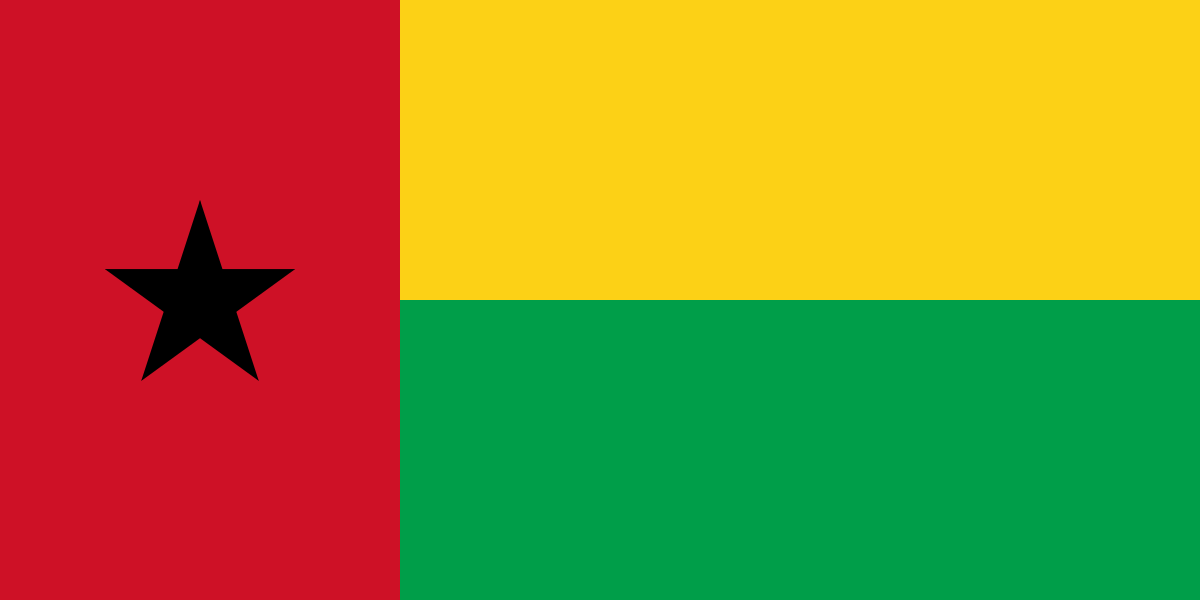
🏛️ Capital
Bissau
👥 Population
1,781,308
📐 Area
36,125 km²
💱 Currency
West African CFA franc (Fr)
🗣️ Languages
Portuguese, Upper Guinea Creole
📞 Calling Code
+245
🕐 Time Zones
UTC
🌐 Region
Africa / Western Africa
About Guinea-Bissau
Guinea-Bissau is one of West Africa's smallest and least-visited nations, a place where the rhythms of life move at the pace of the tides and the air carries the salt of a thousand estuaries. Wedged between Senegal to the north and Guinea to the south, this tiny country of mangrove-laced rivers, cashew groves, and wide Atlantic beaches rewards the genuinely adventurous traveler with experiences that feel completely untouched by mass tourism. The capital Bissau is a quiet, crumbling city with a faded Portuguese colonial charm and a remarkably easy-going energy.
The country's greatest natural treasure lies offshore in the Bijagós Archipelago — 88 islands and islets scattered across the Atlantic, many uninhabited, that form one of West Africa's most extraordinary marine ecosystems. These islands are home to nesting hippos (one of the very few places in the world where hippos enter saltwater), nesting sea turtles, saltwater crocodiles, and vast colonies of migratory birds. The local Bijagós people, known for their matriarchal society and elaborate initiation ceremonies, have shaped a unique culture that remains largely intact despite centuries of outside contact.
Traveling here requires patience, flexibility, and a sense of adventure. Infrastructure is minimal, electricity unreliable, and paved roads scarce outside the capital. But for those prepared to travel slowly and engage openly with the people and landscapes, Guinea-Bissau offers an Africa that feels genuinely wild and generous in spirit. The sunsets over the estuaries, the sound of drumming from a village at night, the sight of a sea turtle emerging from the dark Atlantic — these are the moments that stay with you long after you leave.
The country's greatest natural treasure lies offshore in the Bijagós Archipelago — 88 islands and islets scattered across the Atlantic, many uninhabited, that form one of West Africa's most extraordinary marine ecosystems. These islands are home to nesting hippos (one of the very few places in the world where hippos enter saltwater), nesting sea turtles, saltwater crocodiles, and vast colonies of migratory birds. The local Bijagós people, known for their matriarchal society and elaborate initiation ceremonies, have shaped a unique culture that remains largely intact despite centuries of outside contact.
Traveling here requires patience, flexibility, and a sense of adventure. Infrastructure is minimal, electricity unreliable, and paved roads scarce outside the capital. But for those prepared to travel slowly and engage openly with the people and landscapes, Guinea-Bissau offers an Africa that feels genuinely wild and generous in spirit. The sunsets over the estuaries, the sound of drumming from a village at night, the sight of a sea turtle emerging from the dark Atlantic — these are the moments that stay with you long after you leave.
History & Background
The territory of Guinea-Bissau was historically part of the Gabu Kingdom, a powerful Mandinka state that controlled much of the region from the 13th century onward and served as an important node in trans-Saharan trade networks. Portuguese navigators arrived on the coast in the 15th century and the territory became a crucial part of Portugal's slave-trading operations, with the port of Cacheu serving as a major embarkation point for enslaved Africans shipped to Brazil and the Caribbean. The brutality and scale of this trade left lasting demographic and social scars across the region.
The 20th century brought one of West Africa's most remarkable independence movements, led by Amílcar Cabral, a revolutionary intellectual who founded the African Party for the Independence of Guinea and Cape Verde (PAIGC). Cabral built a guerrilla force that by the early 1970s controlled most of the country's rural interior and declared independence in 1973 — a year before Portugal itself underwent its own revolution and formally recognized Guinea-Bissau's independence in 1974. Cabral was assassinated in 1973 before seeing independence realized, and remains one of Africa's most admired anticolonial thinkers. Post-independence Guinea-Bissau has been politically turbulent, suffering numerous coups and instability, but its spirit of cultural independence has remained resilient.
The 20th century brought one of West Africa's most remarkable independence movements, led by Amílcar Cabral, a revolutionary intellectual who founded the African Party for the Independence of Guinea and Cape Verde (PAIGC). Cabral built a guerrilla force that by the early 1970s controlled most of the country's rural interior and declared independence in 1973 — a year before Portugal itself underwent its own revolution and formally recognized Guinea-Bissau's independence in 1974. Cabral was assassinated in 1973 before seeing independence realized, and remains one of Africa's most admired anticolonial thinkers. Post-independence Guinea-Bissau has been politically turbulent, suffering numerous coups and instability, but its spirit of cultural independence has remained resilient.
Culture & People
Guinea-Bissau is home to more than 20 ethnic groups, each with distinct languages, traditions, and spiritual practices, creating a cultural mosaic of remarkable diversity for such a small country. The Balanta are the largest group and among the most prominent rice farmers in West Africa, inhabiting the lowland coastal regions and maintaining deep ties to the land. The Bijagós of the offshore islands are perhaps the most culturally distinctive, organized around matrilineal clans and known for elaborate age-grade ceremonies that mark transitions between life stages for both men and women. Women in Bijagós society hold significant social power — an unusual feature in the broader West African context.
Traditional animist beliefs remain strong across much of the country, often intertwined with Islam in the eastern and northern regions or Christianity among some groups. Sacred forests, spirit houses, and ritual ceremonies remain active parts of community life in many villages. Music and dance are central to social expression — the gumbe rhythm, blending African percussion with Portuguese guitar, was born in Guinea-Bissau and spread across the Lusophone world. The colorful pano cloths woven on traditional looms, used for ceremonies and trade, are among the most distinctive crafts in West Africa.
Traditional animist beliefs remain strong across much of the country, often intertwined with Islam in the eastern and northern regions or Christianity among some groups. Sacred forests, spirit houses, and ritual ceremonies remain active parts of community life in many villages. Music and dance are central to social expression — the gumbe rhythm, blending African percussion with Portuguese guitar, was born in Guinea-Bissau and spread across the Lusophone world. The colorful pano cloths woven on traditional looms, used for ceremonies and trade, are among the most distinctive crafts in West Africa.
Food & Cuisine
Guinean-Bissau's cuisine reflects its coastal geography and Portuguese colonial influence in a satisfying blend of fresh seafood, tropical produce, and earthy stews. Rice is the cornerstone of almost every meal — the Balanta people's mastery of coastal rice cultivation has made Guinea-Bissau's rice varieties among the finest in West Africa. Caldo de mancarra, a thick peanut and vegetable broth often enriched with fish or chicken, is perhaps the national dish, warming and deeply satisfying in equal measure. Grilled barracuda, prawns, and oysters harvested fresh from the estuaries are available cheaply along the waterfront and in small restaurants throughout Bissau.
Cashew nuts are both an economic lifeline and a culinary fixture — roasted and salted, they accompany drinks and snacks throughout the country, and cashew season in April and May brings a festive energy to rural areas as the harvest comes in. Caju juice, pressed fresh from cashew apples, is sweet, slightly tangy, and utterly refreshing in the heat. Palm wine tapped fresh from palm trees is drunk widely in rural areas, slightly fermented and pleasantly fizzy. Portuguese-influenced dishes like frango grelhado — grilled chicken with lemon and chili — are staples of Bissau's small restaurant scene, accompanied by fried sweet plantains and simple salads.
Cashew nuts are both an economic lifeline and a culinary fixture — roasted and salted, they accompany drinks and snacks throughout the country, and cashew season in April and May brings a festive energy to rural areas as the harvest comes in. Caju juice, pressed fresh from cashew apples, is sweet, slightly tangy, and utterly refreshing in the heat. Palm wine tapped fresh from palm trees is drunk widely in rural areas, slightly fermented and pleasantly fizzy. Portuguese-influenced dishes like frango grelhado — grilled chicken with lemon and chili — are staples of Bissau's small restaurant scene, accompanied by fried sweet plantains and simple salads.
Top Attractions
- Bijagós Archipelago — A UNESCO Biosphere Reserve of 88 Atlantic islands teeming with saltwater hippos, sea turtles, crocodiles, and extraordinary birdlife, home to the unique matriarchal Bijagós people.
- Orango Islands National Park — The largest of the Bijagós protected areas, protecting hippo populations in saltwater habitat and nesting sea turtles on pristine beaches.
- Bissau's Pidjiguiti Massacre Memorial — A powerful monument at the Bissau dockside marking the 1959 massacre of striking dock workers, a pivotal moment in the independence movement.
- Cacheu Fort — A 17th-century Portuguese colonial fort on the Cacheu River, one of the oldest European buildings in West Africa and a haunting symbol of the slave trade era.
- Lagoas de Cufada Natural Park — A network of freshwater lagoons and forests in the south of the country, supporting remarkable birdlife and West African manatees.
- Bolama Island — The former Portuguese colonial capital, a hauntingly beautiful island of crumbling colonial buildings slowly reclaimed by vegetation and tropical birds.
Practical Travel Tips
- Arrange travel to the Bijagós Archipelago through a Bissau-based operator; boat schedules to the outer islands are irregular and local knowledge is essential for planning logistics.
- Carry all cash you need in West African CFA francs (XOF) before leaving Bissau — ATMs are virtually non-existent outside the capital and credit cards are not accepted anywhere.
- Yellow fever vaccination is mandatory for entry; malaria prophylaxis is strongly recommended as malaria is highly prevalent throughout the country.
- A 4x4 vehicle is necessary for any overland travel outside Bissau, especially during and after the rainy season when roads become deeply rutted.
- Portuguese is the official language, and a basic knowledge is very helpful; Kriolu (Guinea-Bissau Creole) is the widely spoken common language between ethnic groups.
- Power cuts are frequent even in Bissau; bring a portable charger for devices and a headlamp for evenings in places without reliable electricity.
- Permits are required to visit certain protected areas of the Bijagós — arrange these in advance through the Institute of Biodiversity and Protected Areas (IBAP) in Bissau.
Visa Overview
Most visitors to Guinea-Bissau require a visa, which is available on arrival at Osvaldo Vieira International Airport in Bissau for citizens of many nationalities, including the United States, European Union, and United Kingdom — though this policy can change and should be verified before travel. Citizens of ECOWAS member states do not require a visa. A valid passport with at least six months' validity, a return ticket, proof of accommodation, and proof of yellow fever vaccination are typically required. Visa fees and processing vary; checking with the nearest Guinea-Bissau diplomatic mission or a reputable travel agency before departure is strongly advised.
Getting Around
Guinea-Bissau is served by Osvaldo Vieira International Airport in Bissau, with connections to regional African hubs and Lisbon. Within the country, shared taxis (toca-tocas) are the main form of public transport between towns, departing when full from central transport stands. Roads outside Bissau are largely unpaved and 4x4 vehicles are essential for inland travel. Travel to the Bijagós islands requires boat transport — pirogue or motorized canoe — arranged through local operators or hotels in Bissau. Inter-island travel times vary greatly depending on weather and tides.
Safety Notes
Guinea-Bissau has a history of political instability, and the security situation can change quickly during elections or political disputes — monitor travel advisories closely. Petty crime, including bag snatching, is a risk in Bissau markets and crowded areas. Drug trafficking activity exists in the country and travelers should exercise caution and avoid any involvement with unknown individuals offering unsolicited assistance. Malaria is a serious health risk and prophylaxis is essential. Medical facilities are extremely limited throughout the country; travel insurance with emergency medical evacuation coverage is strongly recommended.
Live Exchange Rates
Current exchange rates for currencies used in Guinea-Bissau.
West African CFA franc (XOF) Fr
Updated: 2026-10-06
West African CFA franc (XOF) Fr
Updated: 2026-10-06
| Currency Code | Rate |
|---|---|
| 1INCH | 0.016172 |
| AAVE | 0.000009 |
| ADA | 0.006345 |
| AED | 0.006279 |
| AFN | 0.110466 |
| AKT | 0.002234 |
| ALGO | 0.013313 |
| ALL | 0.140236 |
| AMD | 0.618528 |
| AMP | 2.666326 |
| ANG | 0.003074 |
| AOA | 1.566103 |
| APE | 0.010671 |
| APT | 0.002082 |
| AR | 0.000379 |
| ARB | 0.008386 |
| ARS | 2.598603 |
| ATOM | 0.000939 |
| ATS | 0.020977 |
| AUD | 0.002453 |
| AVAX | 0.000151 |
| AWG | 0.003060 |
| AXS | 0.001305 |
| AZM | 14.532610 |
| AZN | 0.002907 |
| BAKE | 6.660975 |
| BAM | 0.002982 |
| BAT | 0.016208 |
| BBD | 0.003419 |
| BCH | 0.000005 |
| BDT | 0.210173 |
| BEF | 0.061498 |
| BGN | 0.002982 |
| BHD | 0.000643 |
| BIF | 5.136646 |
| BMD | 0.001710 |
| BNB | 0.000002 |
| BND | 0.002188 |
| BOB | 0.020509 |
| BRL | 0.008546 |
| BSD | 0.001710 |
| BSV | 0.000086 |
| BSW | 4.154808 |
| BTC | 0.000000 |
| BTCB | 0.024470 |
| BTG | 0.002592 |
| BTN | 0.164846 |
| BTT | 4,598.815856 |
| BUSD | 0.001709 |
| BWP | 0.023531 |
| BYN | 0.005216 |
| BYR | 33.514667 |
| BZD | 0.003438 |
| CAD | 0.002439 |
| CAKE | 0.000699 |
| CDF | 3.951099 |
| CELO | 0.016440 |
| CFX | 0.031158 |
| CHF | 0.001422 |
| CHZ | 0.102208 |
| CLP | 1.663583 |
| CNH | 0.011460 |
| CNY | 0.011464 |
| COMP | 0.000070 |
| COP | 5.468699 |
| CRC | 0.782334 |
| CRO | 0.025177 |
| CRV | 0.004638 |
| CSPR | 0.670257 |
| CUC | 0.001710 |
| CUP | 0.040954 |
| CVE | 0.168106 |
| CVX | 0.000772 |
| CYP | 0.000892 |
| CZK | 0.037295 |
| DAI | 0.001710 |
| DASH | 0.000030 |
| DCR | 0.000093 |
| DEM | 0.002982 |
| DFI | 1.870666 |
| DJF | 0.304156 |
| DKK | 0.011394 |
| DOGE | 0.018031 |
| DOP | 0.102464 |
| DOT | 0.001382 |
| DYDX | 0.011702 |
| DZD | 0.229828 |
| EEK | 0.023853 |
| EGLD | 0.000383 |
| EGP | 0.089636 |
| ENJ | 0.051645 |
| EOS | 0.016824 |
| ERN | 0.025645 |
| ESP | 0.253654 |
| ETB | 0.278102 |
| ETC | 0.000193 |
| ETH | 0.000001 |
| EUR | 0.001524 |
| EURC | 0.001524 |
| FEI | 0.001710 |
| FIL | 0.001432 |
| FIM | 0.009064 |
| FJD | 0.003847 |
| FKP | 0.001294 |
| FLOW | 0.054037 |
| FLR | 0.237191 |
| FRAX | 0.001727 |
| FRF | 0.0100 |
| FTT | 0.006618 |
| GALA | 0.705659 |
| GBP | 0.001294 |
| GEL | 0.004437 |
| GGP | 0.001294 |
| GHC | 201.003012 |
| GHS | 0.020100 |
| GIP | 0.001294 |
| GMD | 0.126536 |
| GMX | 0.000195 |
| GNF | 15.031930 |
| GNO | 0.000014 |
| GRD | 0.519470 |
| GRT | 0.058718 |
| GT | 0.000153 |
| GTQ | 0.013047 |
| GUSD | 0.001713 |
| GYD | 0.356898 |
| HBAR | 0.016984 |
| HKD | 0.013417 |
| HNL | 0.045843 |
| HNT | 0.003295 |
| HOT | 3.733288 |
| HRK | 0.011486 |
| HT | 0.046875 |
| HTG | 0.223409 |
| HUF | 0.560026 |
| ICP | 0.000490 |
| IDR | 30.629604 |
| IEP | 0.001201 |
| ILS | 0.005229 |
| IMP | 0.001294 |
| IMX | 0.009324 |
| INJ | 0.000226 |
| INR | 0.164846 |
| IQD | 2.235151 |
| IRR | 3,074.932254 |
| ISK | 0.208750 |
| ITL | 2.951825 |
| JEP | 0.001294 |
| JMD | 0.270552 |
| JOD | 0.001212 |
| JPY | 0.270322 |
| KAS | 0.039852 |
| KAVA | 0.024662 |
| KCS | 0.000225 |
| KDA | 0.175117 |
| KES | 0.221934 |
| KGS | 0.149528 |
| KHR | 6.926154 |
| KLAY | 0.041051 |
| KMF | 0.7500 |
| KNC | 0.011936 |
| KPW | 1.538939 |
| KRW | 2.295205 |
| KSM | 0.000334 |
| KWD | 0.000528 |
| KYD | 0.001421 |
| KZT | 0.778388 |
| LAK | 38.363395 |
| LBP | 154.184797 |
| LDO | 0.003732 |
| LEO | 0.000192 |
| LINK | 0.000124 |
| LKR | 0.563913 |
| LRC | 0.166526 |
| LRD | 0.291758 |
| LSL | 0.028465 |
| LTC | 0.000025 |
| LTL | 0.005264 |
| LUF | 0.061498 |
| LUNA | 0.033480 |
| LUNC | 32.334184 |
| LVL | 0.001071 |
| LYD | 0.010970 |
| MAD | 0.017064 |
| MANA | 0.016533 |
| MBX | 0.057807 |
| MDL | 0.030641 |
| MGA | 7.571289 |
| MGF | 37.856444 |
| MINA | 0.012690 |
| MKD | 0.093797 |
| MKR | 0.000001 |
| MMK | 3.588949 |
| MNT | 6.146655 |
| MOP | 0.013819 |
| MRO | 0.684510 |
| MRU | 0.068451 |
| MTL | 0.000654 |
| MUR | 0.081043 |
| MVR | 0.026431 |
| MWK | 2.959191 |
| MXN | 0.030903 |
| MXV | 0.003513 |
| MYR | 0.006985 |
| MZM | 109.128572 |
| MZN | 0.109129 |
| NAD | 0.028465 |
| NEAR | 0.000327 |
| NEO | 0.000675 |
| NEXO | 0.002011 |
| NFT | 7,164.758710 |
| NGN | 2.260294 |
| NIO | 0.062854 |
| NLG | 0.003360 |
| NOK | 0.016409 |
| NPR | 0.263876 |
| NZD | 0.003055 |
| OKB | 0.000013 |
| OMR | 0.000658 |
| ONE | 0.011673 |
| OP | 0.012718 |
| ORDI | 0.000376 |
| PAB | 0.001710 |
| PAXG | 0.000000 |
| PEN | 0.005887 |
| PEPE | 395.320534 |
| PGK | 0.007703 |
| PHP | 0.107448 |
| PI | 0.019586 |
| PKR | 0.472731 |
| PLN | 0.006678 |
| POL | 0.015634 |
| PTE | 0.305633 |
| PYG | 9.988022 |
| QAR | 0.006223 |
| QNT | 0.000007 |
| QTUM | 0.001744 |
| ROL | 81.489320 |
| RON | 0.008149 |
| RPL | 0.000894 |
| RSD | 0.179058 |
| RUB | 0.145050 |
| RUNE | 0.002202 |
| RVN | 0.696833 |
| RWF | 2.520041 |
| SAND | 0.026000 |
| SAR | 0.006411 |
| SBD | 0.013795 |
| SCR | 0.024216 |
| SDD | 102.612611 |
| SDG | 1.026126 |
| SEK | 0.017173 |
| SGD | 0.002188 |
| SHIB | 292.068231 |
| SHP | 0.001294 |
| SIT | 0.365329 |
| SKK | 0.045927 |
| SLE | 0.039417 |
| SLL | 39.416840 |
| SNX | 0.006829 |
| SOL | 0.000014 |
| SOS | 0.972735 |
| SPL | 0.000285 |
| SRD | 0.064465 |
| SRG | 64.465465 |
| SSP | 9.790803 |
| STD | 37.614696 |
| STN | 0.037615 |
| STX | 0.004562 |
| SUI | 0.001433 |
| SVC | 0.014960 |
| SYP | 22.232536 |
| SZL | 0.028465 |
| THB | 0.057548 |
| THETA | 0.007383 |
| TJS | 0.015735 |
| TMM | 29.999837 |
| TMT | 0.006000 |
| TND | 0.005117 |
| TOP | 0.004118 |
| TRL | 84,075.284543 |
| TRX | 0.005088 |
| TRY | 0.084075 |
| TTD | 0.011576 |
| TUSD | 0.001711 |
| TVD | 0.002453 |
| TWD | 0.054337 |
| TWT | 0.002995 |
| TZS | 4.510839 |
| UAH | 0.077003 |
| UGX | 6.873225 |
| UNI | 0.000193 |
| USD | 0.001710 |
| USDC | 0.001710 |
| USDD | 0.001711 |
| USDP | 0.001720 |
| USDT | 0.001711 |
| UYU | 0.069065 |
| UZS | 20.111327 |
| VAL | 2.951825 |
| VEB | 148,867,379.761534 |
| VED | 1.488674 |
| VEF | 148,867.379762 |
| VES | 1.488674 |
| VET | 0.195918 |
| VND | 44.444162 |
| VUV | 0.205526 |
| WAVES | 0.005731 |
| WEMIX | 0.008928 |
| WOO | 0.124901 |
| WST | 0.004758 |
| XAF | 1.0000 |
| XAG | 0.000028 |
| XAU | 0.000000 |
| XAUT | 0.000000 |
| XBT | 0.000000 |
| XCD | 0.004628 |
| XCG | 0.003074 |
| XCH | 0.001092 |
| XDC | 0.050876 |
| XDR | 0.001264 |
| XEC | 214.397689 |
| XEM | 2.723187 |
| XLM | 0.007922 |
| XMR | 0.000003 |
| XPD | 0.000001 |
| XPF | 0.181920 |
| XPT | 0.000001 |
| XRP | 0.001138 |
| XTZ | 0.005117 |
| YER | 0.403826 |
| ZAR | 0.028465 |
| ZEC | 0.000001 |
| ZIL | 0.468527 |
| ZMK | 33.801278 |
| ZMW | 0.033801 |
| ZWD | 0.618739 |
| ZWG | 0.045771 |
| ZWL | 114.369505 |
No currencies match your search.
Cities in Guinea-Bissau 51
Browse all cities and towns
Cities in Guinea-Bissau 51
Browse all cities and towns
Bafatá
Bafata
Bambadinca
Bigene
Bijine
Binar
Bissau
Bissora
Bissorã
Boé
Bolama
Buba
Bubaque
Bula
Cacheu
Cacheu
Cacine
Caió
Canchungo
Canchungo
Catio
Catió
Contuboel
Cufar
Cuntuba
Empada
Farim
Farim
Fulacunda
Fulacunda
Gã-Mamudo
Gabu
Gabu
Galomaro
Ingoré
Jabicunda
Mansabá
Mansoa
Mansoa
Nhacra
Pirada
Pitche
Prabis
Quebo
Quebo
Quinhamel
Safim
São Domingos
Sonaco
Tite
Xitole
Visa Requirements
Check what visa a citizen of Guinea-Bissau needs to enter any country.
Frequently Asked Questions
What is the capital of Guinea-Bissau?
The capital of Guinea-Bissau is Bissau.
What currency does Guinea-Bissau use?
Guinea-Bissau uses the West African CFA franc (Fr) as its official currency.
What language is spoken in Guinea-Bissau?
The official language(s) of Guinea-Bissau include Portuguese, Upper Guinea Creole.
What is the population of Guinea-Bissau?
Guinea-Bissau has a population of approximately 1,781,308 people.
What region is Guinea-Bissau in?
Guinea-Bissau is located in Africa, specifically in the Western Africa subregion.
What is the international calling code for Guinea-Bissau?
The international dialing code for Guinea-Bissau is +245.
What time zones does Guinea-Bissau observe?
Guinea-Bissau observes the following time zone(s): UTC.
What is the current time in Guinea-Bissau?
The local time in Guinea-Bissau is currently --:--. This time applies to the primary time zone.
What is the total area of Guinea-Bissau?
Guinea-Bissau covers a total area of 36,125 km².
How many states or provinces does Guinea-Bissau have?
Guinea-Bissau is divided into 15 states or provinces.
What are the public holidays in Guinea-Bissau in 2026?
You can view the complete list of public holidays for Guinea-Bissau in 2026 on the Holidays 2026 page.
What are the visa requirements for citizens of Guinea-Bissau?
Visa requirements for citizens of Guinea-Bissau vary by destination. Use our Visa Requirements Checker below to look up requirements for any destination country.