
Africa · Middle Africa
Angola
Republic of Angola
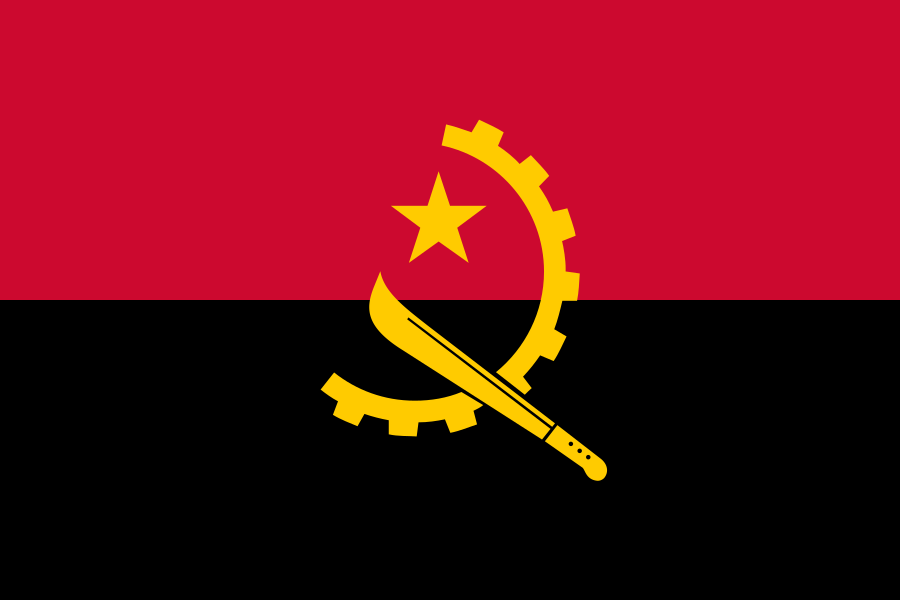
🏛️ Capital
Luanda
👥 Population
36,170,961
📐 Area
1,246,700 km²
💱 Currency
Angolan kwanza (Kz)
🗣️ Languages
Portuguese
📞 Calling Code
+244
🕐 Time Zones
UTC+01:00
🌐 Region
Africa / Middle Africa
About Angola
Angola is a country of staggering natural beauty and extraordinary cultural depth that is only now beginning to emerge on the international travel radar after decades of civil conflict. Stretching along Africa's Atlantic coast with the Congo Basin rainforest to the north and the Namib Desert reaching its northern fingers into the south, Angola's landscapes encompass some of the most dramatic and diverse scenery on the continent. The capital Luanda, one of Africa's most expensive and cosmopolitan cities, buzzes with an infectious energy fuelled by oil wealth, an ambitious rebuilding programme, and a vibrant music scene that has produced kuduro, one of Africa's most influential dance music genres.
Beyond Luanda, Angola reveals landscapes of breathtaking variety. The Tundavala Fissure near Lubango offers vertiginous cliff views over the Namib escarpment. The Bicuar and Quiçama national parks are being painstakingly restocked after the devastating losses of the civil war era. The Kissama National Park, just two hours from Luanda, has become a symbol of conservation hope — elephants, giant sable antelope, and other wildlife are gradually returning through ambitious rewilding initiatives. In the southern highlands, the ancient Muila people maintain striking traditional dress and customs that have survived centuries of change.
Angola is not yet an easy destination, and infrastructure outside the major cities can be challenging. But for the adventurous traveller willing to engage with a country in the midst of a genuine renaissance, Angola offers the rare thrill of experiencing Africa's next great travel discovery before the crowds arrive. The warmth of Angolan hospitality, the richness of its art and music, and the magnificence of its untouched landscapes are rewards well worth the effort of getting here.
Beyond Luanda, Angola reveals landscapes of breathtaking variety. The Tundavala Fissure near Lubango offers vertiginous cliff views over the Namib escarpment. The Bicuar and Quiçama national parks are being painstakingly restocked after the devastating losses of the civil war era. The Kissama National Park, just two hours from Luanda, has become a symbol of conservation hope — elephants, giant sable antelope, and other wildlife are gradually returning through ambitious rewilding initiatives. In the southern highlands, the ancient Muila people maintain striking traditional dress and customs that have survived centuries of change.
Angola is not yet an easy destination, and infrastructure outside the major cities can be challenging. But for the adventurous traveller willing to engage with a country in the midst of a genuine renaissance, Angola offers the rare thrill of experiencing Africa's next great travel discovery before the crowds arrive. The warmth of Angolan hospitality, the richness of its art and music, and the magnificence of its untouched landscapes are rewards well worth the effort of getting here.
History & Background
Angola's recorded history stretches back to the powerful Kingdom of Kongo, which dominated the northern reaches of present-day Angola from the 14th century and developed sophisticated administrative, diplomatic, and artistic traditions long before European contact. Portuguese navigator Diogo Cão arrived at the mouth of the Congo River in 1483, beginning a relationship that would prove catastrophic for the local population. Angola became the largest source of enslaved Africans transported to the Americas — an estimated 4–5 million people were taken from Angolan ports over four centuries, a wound that still shapes the country's relationship with its past.
Portugal maintained Angola as a colony until one of the 20th century's most abrupt decolonisations — independence came on November 11, 1975, almost immediately plunging the country into a devastating civil war between the MPLA government (backed by Cuba and the Soviet Union) and UNITA rebels (backed by the US and South Africa). This conflict lasted 27 years, killing an estimated 500,000 people, displacing millions more, and leaving the country littered with landmines. The death of UNITA leader Jonas Savimbi in 2002 finally ended hostilities, and Angola has since undergone a remarkable if uneven reconstruction, leveraging its vast oil and diamond resources to rebuild its cities and institutions.
Portugal maintained Angola as a colony until one of the 20th century's most abrupt decolonisations — independence came on November 11, 1975, almost immediately plunging the country into a devastating civil war between the MPLA government (backed by Cuba and the Soviet Union) and UNITA rebels (backed by the US and South Africa). This conflict lasted 27 years, killing an estimated 500,000 people, displacing millions more, and leaving the country littered with landmines. The death of UNITA leader Jonas Savimbi in 2002 finally ended hostilities, and Angola has since undergone a remarkable if uneven reconstruction, leveraging its vast oil and diamond resources to rebuild its cities and institutions.
Culture & People
Angolan culture is a vibrant synthesis of Bantu African traditions and centuries of Portuguese colonial influence, producing a society of remarkable creativity and resilience. Portuguese is the official language, but over forty Bantu languages — including Kimbundu, Kikongo, and Umbundu — are spoken across the country, each carrying rich oral traditions, proverbs, and music. The civil war that lasted from 1975 to 2002 profoundly shaped the national psyche, and the arts have been central to healing and reconstruction — Angola's literature, visual art, and music reflect both trauma and an irrepressible vitality.
Music is perhaps Angola's greatest cultural export. Semba, the traditional predecessor to Brazilian samba (the connection is direct and historical), remains a beloved art form, while kuduro — a frenetic electronic dance music born in Luanda's musseques (informal settlements) in the 1980s — has spread globally. Carnival in Luanda, held in February, is one of Africa's most spectacular, rivalling Rio in its scale and ambition. Traditional crafts including basket weaving, woodcarving, and the intricate bead jewellery of the Muila women of the southern highlands represent living artistic traditions that connect contemporary Angolans to their pre-colonial past.
Music is perhaps Angola's greatest cultural export. Semba, the traditional predecessor to Brazilian samba (the connection is direct and historical), remains a beloved art form, while kuduro — a frenetic electronic dance music born in Luanda's musseques (informal settlements) in the 1980s — has spread globally. Carnival in Luanda, held in February, is one of Africa's most spectacular, rivalling Rio in its scale and ambition. Traditional crafts including basket weaving, woodcarving, and the intricate bead jewellery of the Muila women of the southern highlands represent living artistic traditions that connect contemporary Angolans to their pre-colonial past.
Food & Cuisine
Angolan cuisine reflects the country's Portuguese colonial history and the rich agricultural traditions of its Bantu peoples, producing a cooking style that is bold, satisfying, and deeply flavourful. Muamba de galinha — chicken slow-cooked in a rich palm oil sauce with garlic, tomatoes, chilli, and okra — is considered the national dish, a wonderfully aromatic stew that embodies the Portuguese-African fusion at the heart of Angolan cooking. Calulu, a dried fish and vegetable stew cooked in palm oil with sweet potato leaves, is another staple that has nourished Angolans across generations and social classes.
Seafood is excellent given Angola's extensive Atlantic coastline — grilled tiger prawns, fish stews, and fresh lobster are highlights along the coast and in Luanda's better restaurants. Funje, a smooth cassava porridge similar to ugali or sadza, is the universal accompaniment to meat and fish dishes. Ginguba (peanuts) appear in sauces, snacks, and street food across the country. Portuguese influence persists strongly in the prevalence of pastéis de nata (custard tarts), good espresso, and the quality of Angolan beer — Cuca, Eka, and N'Gola lager are refreshing local brews that pair perfectly with a plate of piri-piri prawns.
Seafood is excellent given Angola's extensive Atlantic coastline — grilled tiger prawns, fish stews, and fresh lobster are highlights along the coast and in Luanda's better restaurants. Funje, a smooth cassava porridge similar to ugali or sadza, is the universal accompaniment to meat and fish dishes. Ginguba (peanuts) appear in sauces, snacks, and street food across the country. Portuguese influence persists strongly in the prevalence of pastéis de nata (custard tarts), good espresso, and the quality of Angolan beer — Cuca, Eka, and N'Gola lager are refreshing local brews that pair perfectly with a plate of piri-piri prawns.
Top Attractions
- Kalandula Falls — One of Africa's largest waterfalls by volume, plunging 105 metres over a 400-metre wide horseshoe of red rock in a remote forested setting of extraordinary beauty.
- Kissama National Park — Angola's flagship wildlife reserve, two hours south of Luanda, where ambitious rewilding has returned elephants, sable antelope, and zebra to the savanna.
- Tundavala Fissure — A dramatic escarpment near Lubango offering vertiginous views across the Namib Desert plateau, one of Africa's most spectacular viewpoints.
- Luanda Marginal — The sweeping seafront promenade of the capital, lined with palms, cafes, and the restored colonial buildings of the Ilha de Luanda sandbar.
- Pungo Andongo — Massive black granite inselbergs rising from the savanna, steeped in Mbundu legend and featuring the 'footprints of Queen Njinga,' a revered national symbol.
- Mussulo Peninsula — A palm-fringed sandbar near Luanda with calm lagoon beaches, seafood restaurants, and weekend escape vibes popular with Luanda residents.
Practical Travel Tips
- A visa is required for most nationalities — apply well in advance and ensure your passport has at least six months' validity; yellow fever vaccination proof is mandatory for entry.
- Luanda is one of Africa's most expensive cities; budget carefully and carry a mix of US dollars (widely accepted) and Angolan kwanza (AOA) for markets and local services.
- Road conditions outside major cities can be very poor; hiring a local driver or joining an organised tour is strongly recommended for exploring the interior.
- Photography requires sensitivity — avoid photographing government buildings, military installations, and airports; always ask permission before photographing people.
- Malaria is endemic in Angola; take prophylaxis, use insect repellent, and sleep under a treated mosquito net, especially in rural areas.
- Register with your embassy upon arrival and monitor FCO/State Department travel advisories — some areas may have specific safety considerations.
- English is not widely spoken outside tourist-facing businesses and hotels; a working knowledge of Portuguese is a significant practical advantage.
Visa Overview
Most foreign nationals require a visa to enter Angola, which must be obtained before arrival from an Angolan embassy or, in some cases, as an e-visa. Yellow fever vaccination certification is compulsory for all visitors. Visa applications typically require supporting documents including hotel confirmations, an itinerary, and a letter of invitation or purpose of visit. Processing times and requirements vary; apply well in advance. Some nationalities benefit from visa-on-arrival or simplified procedures — always verify current requirements through the official Angolan Ministry of Foreign Affairs or your embassy.
Getting Around
Luanda's Quatro de Fevereiro International Airport connects to major African hubs, Lisbon, Dubai, and increasingly other destinations. Domestic flights via TAAG Angola Airlines and other carriers reach Lubango, Huambo, Cabinda, and other key cities. Road conditions vary dramatically — major highways have improved, but many secondary routes remain poor and require 4WD vehicles. Candongueiros (shared minibuses) are the primary local transport in cities but can be crowded. Hiring a private driver is the most practical option for visitors exploring beyond Luanda. Car rental is available but driving independently outside the capital is not recommended for first-time visitors.
Safety Notes
Luanda and the major provincial cities are generally manageable for travellers who take standard precautions. Petty crime, including bag snatching and theft, occurs in busy urban areas — avoid displaying expensive equipment and use reputable taxis or hotel cars rather than hailing vehicles on the street. The Cabinda enclave requires additional care and current travel advice should be checked. Landmines remain a legacy risk in some rural areas far from established tourist routes — never stray from marked paths in the countryside and follow local guidance. Comprehensive travel and medical evacuation insurance is essential.
Live Exchange Rates
Current exchange rates for currencies used in Angola.
Angolan kwanza (AOA) Kz
Updated: 2026-10-06
Angolan kwanza (AOA) Kz
Updated: 2026-10-06
| Currency Code | Rate |
|---|---|
| 1INCH | 0.010326 |
| AAVE | 0.000006 |
| ADA | 0.004051 |
| AED | 0.004009 |
| AFN | 0.070535 |
| AKT | 0.001427 |
| ALGO | 0.008500 |
| ALL | 0.089545 |
| AMD | 0.394947 |
| AMP | 1.702523 |
| ANG | 0.001963 |
| APE | 0.006814 |
| APT | 0.001330 |
| AR | 0.000242 |
| ARB | 0.005355 |
| ARS | 1.659280 |
| ATOM | 0.000600 |
| ATS | 0.013395 |
| AUD | 0.001567 |
| AVAX | 0.000096 |
| AWG | 0.001954 |
| AXS | 0.000834 |
| AZM | 9.279474 |
| AZN | 0.001856 |
| BAKE | 4.253217 |
| BAM | 0.001904 |
| BAT | 0.010349 |
| BBD | 0.002183 |
| BCH | 0.000003 |
| BDT | 0.134201 |
| BEF | 0.039268 |
| BGN | 0.001904 |
| BHD | 0.000410 |
| BIF | 3.279891 |
| BMD | 0.001092 |
| BNB | 0.000001 |
| BND | 0.001397 |
| BOB | 0.013096 |
| BRL | 0.005457 |
| BSD | 0.001092 |
| BSV | 0.000055 |
| BSW | 2.652960 |
| BTC | 0.000000 |
| BTCB | 0.015625 |
| BTG | 0.001655 |
| BTN | 0.105258 |
| BTT | 2,936.471394 |
| BUSD | 0.001092 |
| BWP | 0.015025 |
| BYN | 0.003330 |
| BYR | 21.400044 |
| BZD | 0.002195 |
| CAD | 0.001558 |
| CAKE | 0.000446 |
| CDF | 2.522886 |
| CELO | 0.010497 |
| CFX | 0.019896 |
| CHF | 0.000908 |
| CHZ | 0.065263 |
| CLP | 1.062244 |
| CNH | 0.007318 |
| CNY | 0.007320 |
| COMP | 0.000045 |
| COP | 3.491916 |
| CRC | 0.499542 |
| CRO | 0.016076 |
| CRV | 0.002961 |
| CSPR | 0.427978 |
| CUC | 0.001092 |
| CUP | 0.026150 |
| CVE | 0.107340 |
| CVX | 0.000493 |
| CYP | 0.000570 |
| CZK | 0.023814 |
| DAI | 0.001092 |
| DASH | 0.000019 |
| DCR | 0.000059 |
| DEM | 0.001904 |
| DFI | 1.194472 |
| DJF | 0.194212 |
| DKK | 0.007275 |
| DOGE | 0.011514 |
| DOP | 0.065426 |
| DOT | 0.000882 |
| DYDX | 0.007472 |
| DZD | 0.146752 |
| EEK | 0.015231 |
| EGLD | 0.000244 |
| EGP | 0.057235 |
| ENJ | 0.032977 |
| EOS | 0.010743 |
| ERN | 0.016375 |
| ESP | 0.161965 |
| ETB | 0.177576 |
| ETC | 0.000123 |
| ETH | 0.000000 |
| EUR | 0.000973 |
| EURC | 0.000973 |
| FEI | 0.001092 |
| FIL | 0.000915 |
| FIM | 0.005788 |
| FJD | 0.002456 |
| FKP | 0.000826 |
| FLOW | 0.034504 |
| FLR | 0.151453 |
| FRAX | 0.001103 |
| FRF | 0.006385 |
| FTT | 0.004226 |
| GALA | 0.450583 |
| GBP | 0.000826 |
| GEL | 0.002833 |
| GGP | 0.000826 |
| GHC | 128.345994 |
| GHS | 0.012835 |
| GIP | 0.000826 |
| GMD | 0.080797 |
| GMX | 0.000124 |
| GNF | 9.598304 |
| GNO | 0.000009 |
| GRD | 0.331696 |
| GRT | 0.037493 |
| GT | 0.000098 |
| GTQ | 0.008331 |
| GUSD | 0.001094 |
| GYD | 0.227889 |
| HBAR | 0.010844 |
| HKD | 0.008567 |
| HNL | 0.029272 |
| HNT | 0.002104 |
| HOT | 2.383808 |
| HRK | 0.007334 |
| HT | 0.029931 |
| HTG | 0.142653 |
| HUF | 0.357592 |
| ICP | 0.000313 |
| IDR | 19.557851 |
| IEP | 0.000767 |
| ILS | 0.003339 |
| IMP | 0.000826 |
| IMX | 0.005954 |
| INJ | 0.000144 |
| INR | 0.105258 |
| IQD | 1.427206 |
| IRR | 1,963.429475 |
| ISK | 0.133293 |
| ITL | 1.884822 |
| JEP | 0.000826 |
| JMD | 0.172755 |
| JOD | 0.000774 |
| JPY | 0.172608 |
| KAS | 0.025447 |
| KAVA | 0.015747 |
| KCS | 0.000144 |
| KDA | 0.111817 |
| KES | 0.141711 |
| KGS | 0.095478 |
| KHR | 4.422541 |
| KLAY | 0.026212 |
| KMF | 0.478896 |
| KNC | 0.007622 |
| KPW | 0.982655 |
| KRW | 1.465552 |
| KSM | 0.000213 |
| KWD | 0.000337 |
| KYD | 0.000908 |
| KZT | 0.497022 |
| LAK | 24.496091 |
| LBP | 98.451267 |
| LDO | 0.002383 |
| LEO | 0.000123 |
| LINK | 0.000079 |
| LKR | 0.360074 |
| LRC | 0.106332 |
| LRD | 0.186295 |
| LSL | 0.018175 |
| LTC | 0.000016 |
| LTL | 0.003361 |
| LUF | 0.039268 |
| LUNA | 0.021378 |
| LUNC | 20.646273 |
| LVL | 0.000684 |
| LYD | 0.007004 |
| MAD | 0.010896 |
| MANA | 0.010557 |
| MBX | 0.036912 |
| MDL | 0.019565 |
| MGA | 4.834478 |
| MGF | 24.172389 |
| MINA | 0.008103 |
| MKD | 0.059892 |
| MKR | 0.000001 |
| MMK | 2.291644 |
| MNT | 3.924810 |
| MOP | 0.008824 |
| MRO | 0.437079 |
| MRU | 0.043708 |
| MTL | 0.000418 |
| MUR | 0.051748 |
| MVR | 0.016877 |
| MWK | 1.889526 |
| MXN | 0.019733 |
| MXV | 0.002243 |
| MYR | 0.004460 |
| MZM | 69.681618 |
| MZN | 0.069682 |
| NAD | 0.018175 |
| NEAR | 0.000209 |
| NEO | 0.000431 |
| NEXO | 0.001284 |
| NFT | 4,574.897029 |
| NGN | 1.443260 |
| NIO | 0.040134 |
| NLG | 0.002145 |
| NOK | 0.010478 |
| NPR | 0.168492 |
| NZD | 0.001950 |
| OKB | 0.000008 |
| OMR | 0.000420 |
| ONE | 0.007454 |
| OP | 0.008121 |
| ORDI | 0.000240 |
| PAB | 0.001092 |
| PAXG | 0.000000 |
| PEN | 0.003759 |
| PEPE | 252.423118 |
| PGK | 0.004918 |
| PHP | 0.068609 |
| PI | 0.012506 |
| PKR | 0.301852 |
| PLN | 0.004264 |
| POL | 0.009983 |
| PTE | 0.195155 |
| PYG | 6.377629 |
| QAR | 0.003974 |
| QNT | 0.000004 |
| QTUM | 0.001114 |
| ROL | 52.033189 |
| RON | 0.005203 |
| RPL | 0.000571 |
| RSD | 0.114334 |
| RUB | 0.092619 |
| RUNE | 0.001406 |
| RVN | 0.444947 |
| RWF | 1.609116 |
| SAND | 0.016601 |
| SAR | 0.004094 |
| SBD | 0.008808 |
| SCR | 0.015462 |
| SDD | 65.520996 |
| SDG | 0.655210 |
| SEK | 0.010966 |
| SGD | 0.001397 |
| SHIB | 186.493661 |
| SHP | 0.000826 |
| SIT | 0.233273 |
| SKK | 0.029326 |
| SLE | 0.025169 |
| SLL | 25.168745 |
| SNX | 0.004360 |
| SOL | 0.000009 |
| SOS | 0.621118 |
| SPL | 0.000182 |
| SRD | 0.041163 |
| SRG | 41.162986 |
| SSP | 6.251699 |
| STD | 24.018026 |
| STN | 0.024018 |
| STX | 0.002913 |
| SUI | 0.000915 |
| SVC | 0.009552 |
| SYP | 14.196091 |
| SZL | 0.018175 |
| THB | 0.036746 |
| THETA | 0.004715 |
| TJS | 0.010048 |
| TMM | 19.155727 |
| TMT | 0.003831 |
| TND | 0.003267 |
| TOP | 0.002629 |
| TRL | 53,684.399579 |
| TRX | 0.003249 |
| TRY | 0.053684 |
| TTD | 0.007392 |
| TUSD | 0.001093 |
| TVD | 0.001567 |
| TWD | 0.034696 |
| TWT | 0.001912 |
| TZS | 2.880296 |
| UAH | 0.049169 |
| UGX | 4.388744 |
| UNI | 0.000123 |
| USD | 0.001092 |
| USDC | 0.001092 |
| USDD | 0.001092 |
| USDP | 0.001098 |
| USDT | 0.001092 |
| UYU | 0.044100 |
| UZS | 12.841640 |
| VAL | 1.884822 |
| VEB | 95,055,948.283281 |
| VED | 0.950559 |
| VEF | 95,055.948283 |
| VES | 0.950559 |
| VET | 0.125099 |
| VND | 28.378829 |
| VUV | 0.131234 |
| WAVES | 0.003659 |
| WEMIX | 0.005701 |
| WOO | 0.079753 |
| WST | 0.003038 |
| XAF | 0.638528 |
| XAG | 0.000018 |
| XAU | 0.000000 |
| XAUT | 0.000000 |
| XBT | 0.000000 |
| XCD | 0.002955 |
| XCG | 0.001963 |
| XCH | 0.000698 |
| XDC | 0.032486 |
| XDR | 0.000807 |
| XEC | 136.898867 |
| XEM | 1.738830 |
| XLM | 0.005058 |
| XMR | 0.000002 |
| XOF | 0.638528 |
| XPD | 0.000001 |
| XPF | 0.116161 |
| XPT | 0.000001 |
| XRP | 0.000727 |
| XTZ | 0.003267 |
| YER | 0.257854 |
| ZAR | 0.018175 |
| ZEC | 0.000001 |
| ZIL | 0.299167 |
| ZMK | 21.583053 |
| ZMW | 0.021583 |
| ZWD | 0.395082 |
| ZWG | 0.029226 |
| ZWL | 73.028099 |
No currencies match your search.
Cities in Angola 183
Browse all cities and towns
Cities in Angola 183
Browse all cities and towns
Alto Dondo
Alto Hama
Ambriz
Andulo
Bailundo
Balombo
Bembe
Benguela
Bibala
Bocoio
Buco-Zau
Buela
Bundas
Bungo
Caála
Cabinda
Cachoeira
Caconda
Cacongo
Cacuaco
Cacula
Caculama
Cacuso
Cadá
Cáfu
Cafunfo
Cahama
Calai
Calandala
Calandula
Calonda
Calucinga
Calulo
Caluquembe
Camabatela
Camabatela
Camacupa
Camanongue
Camaxilo
Cambandua
Cambundi Catembo
Cangamba
Cangandala
Cangola
Cangundo
Canzar
Cassongue
Catabola
Catchiungo
Catete
Catumbela
Catumbela
Cautoto
Caxito
Cazaje
Cazombo
CENTRALIDADE DO QUIBAÚLA (Sumbe)
Chibia
Chicala
Chinguar
Chipindo
Chissamba
Chongoroi
Cidade do Kilamba
Cuangar
Cuango
Cubal
Cuchi
Cucumbi
Cuemba
Cuilo
Cuima
Cuimba
Cuíto
Cuito Cuanavale
Culo
Cunda-dia-Baze
Cunhinga
Cusse
Cutato
Cuvango
Damba
Dirico
Dombe Grande
Dondo
Dundo
Ecunha
Gabela
Gambos-Chiange
Ganda
Golungo Alto
Hoque
Huambo
Huíla
Humpata
Iongo
Jamba
Jamba
Kuito
Léua
Lobito
Lombe
Longonjo
Lóvua
Luacano
Luanda
Luando
Luao
Luau
Lubango
Lucala
Lucapa
Lucira
Luena
Lumeje
Lumua
Luxilo
M'banza Congo
M'banza-Kongo
Malanje
Maquela do Zombo
Matala
Mavinga
Mbanza Lucala
Mecumba
Menongue
Menongue
Moçâmedes
Mucussuege
Mumbué
Mungo
Munhango
Mussende
Muxaluando
N'dalatando
N'zeto
Namibe
Nana Candundo
Negage
Nóqui
Nova Esperança
Nzagi
Nzeto
Ondjiva
Panguila
Porto Amboim
Porto Quipiri
Praia Santo Antônio
Puri
Quibala
Quibaxe
Quibocolo
Quilenda
Quilengues
Quimbele
Quinzala
Quipungo
Quissaca
Quitapa
Quitexe
Quituia
Salucunda
Sanza Pombo
Sassalemba
Saurimo
Sautar
Seles
Songo
Soyo
Sumbe
Tempué
Tomboco
Tômbua
Uemita
Uíge
Ukuma
Virei
Waku Kungo
Xá-Muteba
Xangongo
Xassengue
Xinge
Zambia
Visa Requirements
Check what visa a citizen of Angola needs to enter any country.
Frequently Asked Questions
What is the capital of Angola?
The capital of Angola is Luanda.
What currency does Angola use?
Angola uses the Angolan kwanza (Kz) as its official currency.
What language is spoken in Angola?
The official language(s) of Angola include Portuguese.
What is the population of Angola?
Angola has a population of approximately 36,170,961 people.
What region is Angola in?
Angola is located in Africa, specifically in the Middle Africa subregion.
What is the international calling code for Angola?
The international dialing code for Angola is +244.
What time zones does Angola observe?
Angola observes the following time zone(s): UTC+01:00.
What is the current time in Angola?
The local time in Angola is currently --:--. This time applies to the primary time zone.
What is the total area of Angola?
Angola covers a total area of 1,246,700 km².
How many states or provinces does Angola have?
Angola is divided into 21 states or provinces.
What are the public holidays in Angola in 2026?
You can view the complete list of public holidays for Angola in 2026 on the Holidays 2026 page.
What are the visa requirements for citizens of Angola?
Visa requirements for citizens of Angola vary by destination. Use our Visa Requirements Checker below to look up requirements for any destination country.