
Oceania · Melanesia
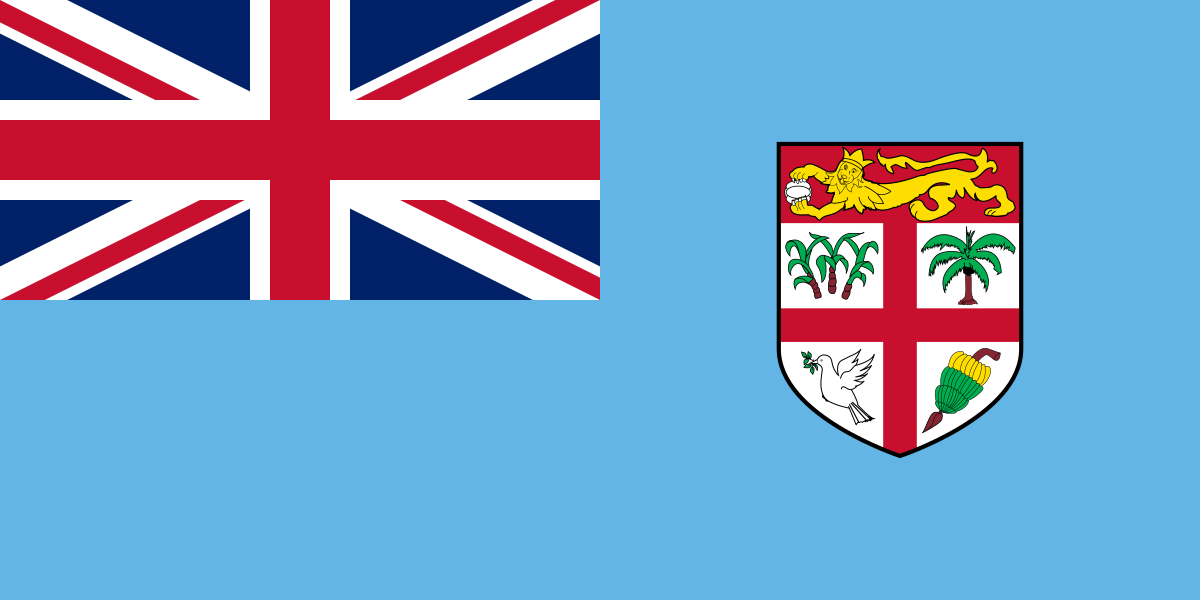
Fiji
Republic of Fiji
🏛️ Capital
Suva
👥 Population
900,869
📐 Area
18,272 km²
💱 Currency
Fijian dollar ($)
🗣️ Languages
English, Fijian, Fiji Hindi
📞 Calling Code
+679
🕐 Time Zones
UTC+12:00
🌐 Region
Oceania / Melanesia
About Fiji
Fiji is the South Pacific as most people picture it — warm turquoise lagoons, overwater bures, palm-fringed beaches glowing white in tropical sunlight, and a welcome so genuine and enthusiastic that it becomes one of the defining memories of any visit. Comprising over 300 islands scattered across the Koro Sea, Fiji is simultaneously an international resort destination and a country of extraordinary natural and cultural depth. The Great Astrolabe Reef, Beqa Lagoon, and the Bligh Waters offer some of the southern hemisphere's finest diving, while the highland interior of Viti Levu harbors ancient forests, waterfall trails, and Fijian villages where traditional life continues largely unchanged.
The famous Fijian greeting — Bula! — is not a performance for tourists. It is the genuine expression of a culture that places human connection and community at the center of everything. Fijians are among the warmest people you will encounter anywhere in the world, and the ease with which village grog ceremonies, family meals, and church services open to respectful visitors is remarkable. Even on the most resort-saturated stretch of the Coral Coast, moments of genuine cultural exchange are readily available to those who seek them.
Fiji divides neatly into two experiences: the well-developed resort infrastructure of the main island's coastal belt and the Mamanuca and Yasawa island chains, and the more remote, less visited outer islands of Kadavu, Taveuni, and the Lau Group. Both reward visitors in their own way. The first offers comfort and convenience within a Pacific paradise setting; the second offers solitude, pristine reef ecosystems, and the feeling of having discovered something that the world hasn't quite reached yet.
The famous Fijian greeting — Bula! — is not a performance for tourists. It is the genuine expression of a culture that places human connection and community at the center of everything. Fijians are among the warmest people you will encounter anywhere in the world, and the ease with which village grog ceremonies, family meals, and church services open to respectful visitors is remarkable. Even on the most resort-saturated stretch of the Coral Coast, moments of genuine cultural exchange are readily available to those who seek them.
Fiji divides neatly into two experiences: the well-developed resort infrastructure of the main island's coastal belt and the Mamanuca and Yasawa island chains, and the more remote, less visited outer islands of Kadavu, Taveuni, and the Lau Group. Both reward visitors in their own way. The first offers comfort and convenience within a Pacific paradise setting; the second offers solitude, pristine reef ecosystems, and the feeling of having discovered something that the world hasn't quite reached yet.
History & Background
Archaeological evidence suggests that Fiji has been inhabited for at least three thousand years, with the original settlers arriving from Vanuatu and the Solomon Islands and bringing a distinctive Lapita pottery culture. Subsequent waves of Melanesian and Polynesian migration created the complex ethnic mosaic reflected in modern Fijian diversity. European contact began with Dutch explorer Abel Tasman in 1643, and the islands gained notoriety among Pacific sailors for their reef-wrecking navigational hazards and the fierce warlike reputation of certain island chiefs — earning the name the Cannibal Isles in early European accounts.
British colonial rule began in 1874 when Ratu Seru Epenisa Cakobau, the paramount chief who had nominally unified much of the archipelago, ceded sovereignty to Queen Victoria. The British introduced indentured Indian labor to work the sugar plantations, transforming Fijian demographics irreversibly. Independence was granted in 1970, but the subsequent decades were turbulent — four coups between 1987 and 2006 disrupted democratic governance before a new constitution was adopted in 2013 and elections restored civilian rule. Fiji now has a functioning democracy and has channeled its considerable natural and cultural assets into a tourism industry that is the country's primary economic engine.
British colonial rule began in 1874 when Ratu Seru Epenisa Cakobau, the paramount chief who had nominally unified much of the archipelago, ceded sovereignty to Queen Victoria. The British introduced indentured Indian labor to work the sugar plantations, transforming Fijian demographics irreversibly. Independence was granted in 1970, but the subsequent decades were turbulent — four coups between 1987 and 2006 disrupted democratic governance before a new constitution was adopted in 2013 and elections restored civilian rule. Fiji now has a functioning democracy and has channeled its considerable natural and cultural assets into a tourism industry that is the country's primary economic engine.
Culture & People
Fijian society is organized around the vanua — a concept that encompasses land, people, and community as a unified whole. The mataqali clan system allocates land rights and social responsibilities along ancestral lines, and the traditional chief, or turaga, still holds genuine authority in village affairs. The yaqona ceremony — communal drinking of kava from a carved tanoa bowl — is the social ritual that underpins nearly every significant interaction, from welcoming visitors to resolving disputes, and participating in it with respect opens many doors. Sevusevu, the offering of kava root to a village's elder, is the proper protocol for visiting traditional communities.
Indo-Fijian culture, rooted in the community descended from indentured Indian laborers brought to Fiji by the British between 1879 and 1916, adds a rich second layer to the national tapestry. Colorful Hindu temples, Diwali celebrations, spiced curries, and Bollywood music coexist with Christian hymn singing, Methodist Sunday observances, and traditional Fijian meke dance performances. The interplay between these two major communities — now joined by Chinese Fijians, Rotumans, and European settlers — creates a cultural complexity that surprises visitors expecting only the stereotypical Pacific paradise.
Indo-Fijian culture, rooted in the community descended from indentured Indian laborers brought to Fiji by the British between 1879 and 1916, adds a rich second layer to the national tapestry. Colorful Hindu temples, Diwali celebrations, spiced curries, and Bollywood music coexist with Christian hymn singing, Methodist Sunday observances, and traditional Fijian meke dance performances. The interplay between these two major communities — now joined by Chinese Fijians, Rotumans, and European settlers — creates a cultural complexity that surprises visitors expecting only the stereotypical Pacific paradise.
Food & Cuisine
Fijian food is a delicious product of cultural fusion. Kokoda — raw fish cured in freshly squeezed citrus juice and mixed with coconut cream, chili, and spring onions — is the national dish and one of the Pacific's finest preparations, best eaten at its freshest from a beachside restaurant. Lovo, the traditional Fijian earth oven cooked underground with heated stones, produces extraordinarily tender meats and root vegetables infused with coconut and banana leaf flavors; lovo feasts are highlights of village visits and resort cultural nights. Palusami — taro leaves baked with coconut cream — is a deeply satisfying accompaniment to almost any main dish.
The Indo-Fijian cooking tradition brings exceptional Indian-style curries made with locally grown vegetables, lentils, and fresh tropical produce that differs from any curry you would find in South Asia. Roti is made fresh daily in Indo-Fijian homes and eaten with dhal, pickles, and chutneys of remarkable complexity. Fresh tropical fruits — papaya, mango, passionfruit, and soursop — are available at roadside stalls throughout the year. Fiji's local Fiji Bitter beer is a satisfying accompaniment to beach meals, and kava, drunk communally in a traditional ceremony, is an experience not to be missed.
The Indo-Fijian cooking tradition brings exceptional Indian-style curries made with locally grown vegetables, lentils, and fresh tropical produce that differs from any curry you would find in South Asia. Roti is made fresh daily in Indo-Fijian homes and eaten with dhal, pickles, and chutneys of remarkable complexity. Fresh tropical fruits — papaya, mango, passionfruit, and soursop — are available at roadside stalls throughout the year. Fiji's local Fiji Bitter beer is a satisfying accompaniment to beach meals, and kava, drunk communally in a traditional ceremony, is an experience not to be missed.
Top Attractions
- Yasawa Island Chain — A necklace of stunning islands with Blue Lagoon beaches, remote villages, snorkeling, and backpacker beach bures away from the resort circuit.
- Beqa Lagoon Shark Dive — One of the world's most famous shark dives, where bull sharks, tiger sharks, and multiple reef species gather at an underwater feeding station.
- Taveuni Island — The Garden Island of Fiji, draped in tropical forest, with Bouma Falls, world-class Rainbow Reef diving, and the International Date Line marker.
- Navala Village — The last traditional Fijian village built entirely of bure thatched houses, set in the Ba highlands and offering authentic village stays.
- Sigatoka Sand Dunes National Park — Ancient sand dunes along the Coral Coast with significant archaeological finds and an easy walking trail with coastal views.
- Garden of the Sleeping Giant — An extraordinary orchid garden near Nadi in the foothills of the Sabeto Mountains, housing one of the Pacific's finest private orchid collections.
Practical Travel Tips
- Most nationalities including US, UK, EU, and Australian citizens can enter Fiji visa-free for up to four months.
- The Fijian dollar (FJD) is the currency; exchange money at airports or banks and carry some cash for smaller islands with no ATMs.
- When visiting a Fijian village, bring sevusevu — a bundle of kava root purchased from any market — as an offering to the village elder before entering.
- Cover shoulders and knees when entering villages and churches; a sulu (wraparound cloth) purchased locally is practical and appreciated.
- The Yasawa Flyer ferry is the budget option for island-hopping the Yasawa chain; book seaplane or fast catamaran for quicker connections.
- Sunscreen, insect repellent, and reef-safe sun protection are essential; the tropical sun is intense even on overcast days.
- Book popular dive operators and liveaboards well in advance, particularly for Beqa Lagoon shark dives and the soft coral sites of Taveuni.
Visa Overview
Citizens of most countries including the United States, United Kingdom, Australia, New Zealand, the European Union, and Canada receive a free tourist visa on arrival valid for up to four months. A valid passport, return ticket, and evidence of sufficient funds for the stay are required. Travelers intending to work or stay longer must apply for the appropriate visa through the Fijian immigration department before travel. Yellow fever vaccination proof is required for travelers arriving from endemic countries.
Getting Around
Nadi International Airport on Viti Levu is the main gateway, served by Fiji Airways and numerous international carriers. Nausori Airport near Suva handles some regional flights. Fiji Airways and Pacific Sun operate an extensive domestic flight network connecting the main islands. The Yasawa Flyer catamaran runs daily from Port Denarau Marina to the Yasawa and Mamanuca island chains. Water taxis and private speedboats connect smaller resorts. Within Viti Levu, buses and minivans operate along the Queens Highway connecting Nadi and Suva.
Safety Notes
Fiji is generally safe for tourists, but standard precautions apply in urban areas. Petty theft occurs in Suva city center and around bus terminals — keep valuables secure. Swimming and snorkeling require awareness of strong currents, particularly around reef passages; heed local advice before entering water. Cyclone season from November to April occasionally brings severe storms; monitor forecasts and follow resort or government emergency guidance. The tap water in Suva and resort areas is safe to drink, but check locally on outer islands.
Live Exchange Rates
Current exchange rates for currencies used in Fiji.
Fijian dollar (FJD) $
Updated: 2026-10-06
Fijian dollar (FJD) $
Updated: 2026-10-06
| Currency Code | Rate |
|---|---|
| 1INCH | 4.203864 |
| AAVE | 0.002445 |
| ADA | 1.649303 |
| AED | 1.632154 |
| AFN | 28.714915 |
| AKT | 0.580740 |
| ALGO | 3.460518 |
| ALL | 36.453690 |
| AMD | 160.782933 |
| AMP | 693.096678 |
| ANG | 0.799175 |
| AOA | 407.099800 |
| APE | 2.773920 |
| APT | 0.541315 |
| AR | 0.098589 |
| ARB | 2.180013 |
| ARS | 675.492566 |
| ATOM | 0.244099 |
| ATS | 5.452971 |
| AUD | 0.637740 |
| AVAX | 0.039142 |
| AWG | 0.795522 |
| AXS | 0.339352 |
| AZM | 3,777.672175 |
| AZN | 0.755534 |
| BAKE | 1,731.483838 |
| BAM | 0.775062 |
| BAT | 4.213255 |
| BBD | 0.888852 |
| BCH | 0.001406 |
| BDT | 54.633276 |
| BEF | 15.986010 |
| BGN | 0.775062 |
| BHD | 0.167104 |
| BIF | 1,335.242961 |
| BMD | 0.444426 |
| BNB | 0.000569 |
| BND | 0.568635 |
| BOB | 5.331283 |
| BRL | 2.221561 |
| BSD | 0.444426 |
| BSV | 0.022256 |
| BSW | 1,080.019580 |
| BTC | 0.000005 |
| BTCB | 6.360782 |
| BTG | 0.673657 |
| BTN | 42.850685 |
| BTT | 1,195,436.917433 |
| BUSD | 0.444351 |
| BWP | 6.116742 |
| BYN | 1.355821 |
| BYR | 8,711.953659 |
| BZD | 0.893783 |
| CAD | 0.634133 |
| CAKE | 0.181731 |
| CDF | 1,027.066479 |
| CELO | 4.273373 |
| CFX | 8.099454 |
| CHF | 0.369652 |
| CHZ | 26.568417 |
| CLP | 432.439371 |
| CNH | 2.978996 |
| CNY | 2.979949 |
| COMP | 0.018132 |
| COP | 1,421.558223 |
| CRC | 203.363481 |
| CRO | 6.544573 |
| CRV | 1.205561 |
| CSPR | 174.229645 |
| CUC | 0.444487 |
| CUP | 10.645694 |
| CVE | 43.698109 |
| CVX | 0.200771 |
| CYP | 0.231934 |
| CZK | 9.694652 |
| DAI | 0.444607 |
| DASH | 0.007840 |
| DCR | 0.024100 |
| DEM | 0.775062 |
| DFI | 486.269289 |
| DJF | 79.063804 |
| DKK | 2.961835 |
| DOGE | 4.687153 |
| DOP | 26.634936 |
| DOT | 0.359199 |
| DYDX | 3.041764 |
| DZD | 59.742597 |
| EEK | 6.200495 |
| EGLD | 0.099438 |
| EGP | 23.300396 |
| ENJ | 13.424813 |
| EOS | 4.373325 |
| ERN | 6.666389 |
| ESP | 65.935917 |
| ETB | 72.291169 |
| ETC | 0.050083 |
| ETH | 0.000165 |
| EUR | 0.396283 |
| EURC | 0.396229 |
| FEI | 0.444620 |
| FIL | 0.372319 |
| FIM | 2.356191 |
| FKP | 0.336331 |
| FLOW | 14.046518 |
| FLR | 61.656423 |
| FRAX | 0.448925 |
| FRF | 2.599445 |
| FTT | 1.720432 |
| GALA | 183.432152 |
| GBP | 0.336331 |
| GEL | 1.153502 |
| GGP | 0.336331 |
| GHC | 52,249.628666 |
| GHS | 5.224963 |
| GIP | 0.336331 |
| GMD | 32.892427 |
| GMX | 0.050617 |
| GNF | 3,907.467709 |
| GNO | 0.003660 |
| GRD | 135.033380 |
| GRT | 15.263313 |
| GT | 0.039700 |
| GTQ | 3.391603 |
| GUSD | 0.445342 |
| GYD | 92.773667 |
| HBAR | 4.414768 |
| HKD | 3.487611 |
| HNL | 11.916762 |
| HNT | 0.856482 |
| HOT | 970.447704 |
| HRK | 2.985793 |
| HT | 12.184845 |
| HTG | 58.074016 |
| HUF | 145.575716 |
| ICP | 0.127463 |
| IDR | 7,961.997353 |
| IEP | 0.312098 |
| ILS | 1.359123 |
| IMP | 0.336331 |
| IMX | 2.423766 |
| INJ | 0.058631 |
| INR | 42.850685 |
| IQD | 581.015126 |
| IRR | 799,311.746793 |
| ISK | 54.263535 |
| ITL | 767.310585 |
| JEP | 0.336331 |
| JMD | 70.328410 |
| JOD | 0.315098 |
| JPY | 70.268808 |
| KAS | 10.359344 |
| KAVA | 6.410723 |
| KCS | 0.058543 |
| KDA | 45.520652 |
| KES | 57.690444 |
| KGS | 38.868904 |
| KHR | 1,800.415624 |
| KLAY | 10.670907 |
| KMF | 194.958380 |
| KNC | 3.102728 |
| KPW | 400.038830 |
| KRW | 596.625828 |
| KSM | 0.086747 |
| KWD | 0.137375 |
| KYD | 0.369457 |
| KZT | 202.337734 |
| LAK | 9,972.353693 |
| LBP | 40,079.491049 |
| LDO | 0.970192 |
| LEO | 0.049978 |
| LINK | 0.032133 |
| LKR | 146.586041 |
| LRC | 43.287611 |
| LRD | 75.840797 |
| LSL | 7.399200 |
| LTC | 0.006380 |
| LTL | 1.368285 |
| LUF | 15.986010 |
| LUNA | 8.702991 |
| LUNC | 8,405.093461 |
| LVL | 0.278508 |
| LYD | 2.851485 |
| MAD | 4.435670 |
| MANA | 4.297638 |
| MBX | 15.026729 |
| MDL | 7.965054 |
| MGA | 1,968.114918 |
| MGF | 9,840.574588 |
| MINA | 3.298667 |
| MKD | 24.381906 |
| MKR | 0.000221 |
| MMK | 932.927643 |
| MNT | 1,597.789278 |
| MOP | 3.592239 |
| MRO | 177.934605 |
| MRU | 17.793460 |
| MTL | 0.170124 |
| MUR | 21.066779 |
| MVR | 6.870676 |
| MWK | 769.225511 |
| MXN | 8.033105 |
| MXV | 0.913206 |
| MYR | 1.815770 |
| MZM | 28,367.372681 |
| MZN | 28.367373 |
| NAD | 7.399200 |
| NEAR | 0.085048 |
| NEO | 0.175351 |
| NEXO | 0.522620 |
| NFT | 1,862,439.665848 |
| NGN | 587.550955 |
| NIO | 16.338504 |
| NLG | 0.873292 |
| NOK | 4.265537 |
| NPR | 68.593233 |
| NZD | 0.794001 |
| OKB | 0.003408 |
| OMR | 0.171041 |
| ONE | 3.034368 |
| OP | 3.306054 |
| ORDI | 0.097678 |
| PAB | 0.444426 |
| PAXG | 0.000108 |
| PEN | 1.530213 |
| PEPE | 102,761.401065 |
| PGK | 2.002261 |
| PHP | 27.930538 |
| PI | 5.091228 |
| PKR | 122.883894 |
| PLN | 1.735968 |
| POL | 4.064052 |
| PTE | 79.447577 |
| PYG | 2,596.331532 |
| QAR | 1.617710 |
| QNT | 0.001718 |
| QTUM | 0.453382 |
| ROL | 21,182.700995 |
| RON | 2.118270 |
| RPL | 0.232417 |
| RSD | 46.545169 |
| RUB | 37.705026 |
| RUNE | 0.572435 |
| RVN | 181.137967 |
| RWF | 655.070875 |
| SAND | 6.758457 |
| SAR | 1.666597 |
| SBD | 3.585935 |
| SCR | 6.294733 |
| SDD | 26,673.584523 |
| SDG | 266.735845 |
| SEK | 4.464111 |
| SGD | 0.568635 |
| SHIB | 75,921.531995 |
| SHP | 0.336331 |
| SIT | 94.965221 |
| SKK | 11.938417 |
| SLE | 10.246191 |
| SLL | 10,246.191095 |
| SNX | 1.775037 |
| SOL | 0.003704 |
| SOS | 252.857214 |
| SPL | 0.074071 |
| SRD | 16.757443 |
| SRG | 16,757.443412 |
| SSP | 2,545.065473 |
| STD | 9,777.733682 |
| STN | 9.777734 |
| STX | 1.185974 |
| SUI | 0.372383 |
| SVC | 3.888727 |
| SYP | 5,779.225699 |
| SZL | 7.399200 |
| THB | 14.959223 |
| THETA | 1.919292 |
| TJS | 4.090336 |
| TMM | 7,798.292694 |
| TMT | 1.559659 |
| TND | 1.330088 |
| TOP | 1.070376 |
| TRL | 21,854,908.333867 |
| TRX | 1.322557 |
| TRY | 21.854908 |
| TTD | 3.009093 |
| TUSD | 0.444777 |
| TVD | 0.637740 |
| TWD | 14.124679 |
| TWT | 0.778507 |
| TZS | 1,172.567767 |
| UAH | 20.016631 |
| UGX | 1,786.657002 |
| UNI | 0.050164 |
| USD | 0.444426 |
| USDC | 0.444547 |
| USDD | 0.444742 |
| USDP | 0.447068 |
| USDT | 0.444651 |
| UYU | 17.953069 |
| UZS | 5,227.828992 |
| VAL | 767.310585 |
| VEB | 38,697,257,538.7909 |
| VED | 386.972575 |
| VEF | 38,697,257.538791 |
| VES | 386.972575 |
| VET | 50.927728 |
| VND | 11,553.015716 |
| VUV | 53.425358 |
| WAVES | 1.489703 |
| WEMIX | 2.320693 |
| WOO | 32.467416 |
| WST | 1.236923 |
| XAF | 259.944506 |
| XAG | 0.007345 |
| XAU | 0.000108 |
| XAUT | 0.000108 |
| XBT | 0.000005 |
| XCD | 1.203026 |
| XCG | 0.799175 |
| XCH | 0.283981 |
| XDC | 13.224987 |
| XDR | 0.328501 |
| XEC | 55,731.501480 |
| XEM | 707.877500 |
| XLM | 2.059261 |
| XMR | 0.000792 |
| XOF | 259.944506 |
| XPD | 0.000381 |
| XPF | 47.289122 |
| XPT | 0.000260 |
| XRP | 0.295795 |
| XTZ | 1.330168 |
| YER | 104.972389 |
| ZAR | 7.399200 |
| ZEC | 0.000332 |
| ZIL | 121.790994 |
| ZMK | 8,786.456645 |
| ZMW | 8.786457 |
| ZWD | 160.837744 |
| ZWG | 11.897962 |
| ZWL | 29,729.724595 |
No currencies match your search.
Visa Requirements
Check what visa a citizen of Fiji needs to enter any country.
Frequently Asked Questions
What is the capital of Fiji?
The capital of Fiji is Suva.
What currency does Fiji use?
Fiji uses the Fijian dollar ($) as its official currency.
What language is spoken in Fiji?
The official language(s) of Fiji include English, Fijian, Fiji Hindi.
What is the population of Fiji?
Fiji has a population of approximately 900,869 people.
What region is Fiji in?
Fiji is located in Oceania, specifically in the Melanesia subregion.
What is the international calling code for Fiji?
The international dialing code for Fiji is +679.
What time zones does Fiji observe?
Fiji observes the following time zone(s): UTC+12:00.
What is the current time in Fiji?
The local time in Fiji is currently --:--. This time applies to the primary time zone.
What is the total area of Fiji?
Fiji covers a total area of 18,272 km².
How many states or provinces does Fiji have?
Fiji is divided into 5 states or provinces.
What are the public holidays in Fiji in 2026?
You can view the complete list of public holidays for Fiji in 2026 on the Holidays 2026 page.
What are the visa requirements for citizens of Fiji?
Visa requirements for citizens of Fiji vary by destination. Use our Visa Requirements Checker below to look up requirements for any destination country.