
Oceania · Micronesia
Marshall Islands
Republic of the Marshall Islands
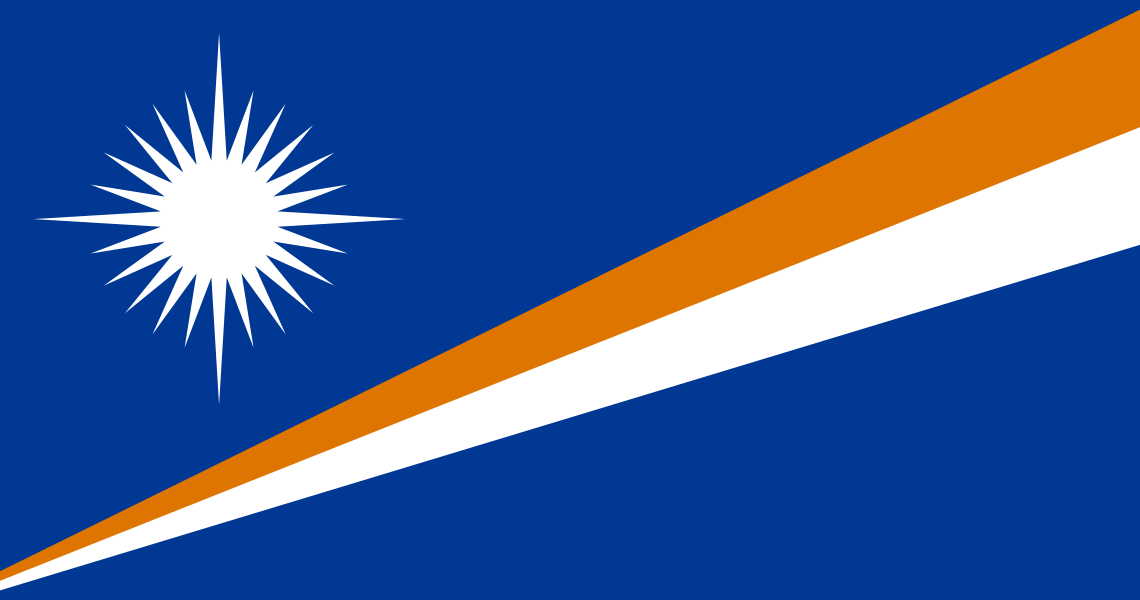
🏛️ Capital
Majuro
👥 Population
42,418
📐 Area
181 km²
💱 Currency
United States dollar ($)
🗣️ Languages
English, Marshallese
📞 Calling Code
+692
🕐 Time Zones
UTC+12:00
🌐 Region
Oceania / Micronesia
About Marshall Islands
The Marshall Islands is one of the Pacific's most remote and extraordinary destinations — a scattered nation of 29 coral atolls and 5 islands strung across more than 1.9 million square kilometres of the central Pacific Ocean, where the vast emptiness of the sea defines everything about life, culture, and survival. To visit the Marshalls is to step into a world of profound oceanic immensity, where the horizon is always water, the sky is impossibly large, and communities have navigated these vast distances for thousands of years without the use of instruments, guided only by the stars, swells, and their own accumulated maritime knowledge.
The Republic of the Marshall Islands offers some of the Pacific's most spectacular diving and snorkeling, with pristine atoll lagoons, dramatic outer reef walls teeming with marine life, and several famous WWII wreck dive sites that are among the most significant in the entire Pacific. Bikini Atoll, a UNESCO World Heritage Site, is the most historic of these — the site of 23 US nuclear bomb tests between 1946 and 1958, its lagoon now holds sunken warships in remarkably preserved condition beneath crystal-clear water, creating one of the world's most haunting and extraordinary dive destinations.
Beyond its underwater attractions, the Marshall Islands presents a compelling human story of resilience, navigational genius, and existential challenge. The Marshallese people are among the world's most threatened communities from rising sea levels, with many atolls facing inundation within decades. Yet the culture, the language, the stick chart navigation tradition, and the warmth of the people who call these atolls home make a visit to the Marshalls an experience of rare depth. Few travelers reach this corner of the Pacific, which means those who do find a genuinely unhurried and authentic encounter with island life at its most elemental.
The Republic of the Marshall Islands offers some of the Pacific's most spectacular diving and snorkeling, with pristine atoll lagoons, dramatic outer reef walls teeming with marine life, and several famous WWII wreck dive sites that are among the most significant in the entire Pacific. Bikini Atoll, a UNESCO World Heritage Site, is the most historic of these — the site of 23 US nuclear bomb tests between 1946 and 1958, its lagoon now holds sunken warships in remarkably preserved condition beneath crystal-clear water, creating one of the world's most haunting and extraordinary dive destinations.
Beyond its underwater attractions, the Marshall Islands presents a compelling human story of resilience, navigational genius, and existential challenge. The Marshallese people are among the world's most threatened communities from rising sea levels, with many atolls facing inundation within decades. Yet the culture, the language, the stick chart navigation tradition, and the warmth of the people who call these atolls home make a visit to the Marshalls an experience of rare depth. Few travelers reach this corner of the Pacific, which means those who do find a genuinely unhurried and authentic encounter with island life at its most elemental.
History & Background
The Marshall Islands has been inhabited by Micronesian seafarers for at least 2,000 years, with oral traditions suggesting settlement came from Southeast Asia via sophisticated long-distance canoe voyaging. The islands were encountered by Spanish explorer Alonso de Salazar in 1526 and named after British Captain William Marshall, who surveyed them in 1788. Germany claimed the islands as a protectorate in 1885, incorporating them into German New Guinea, before Japan seized control during World War I and administered them under a League of Nations mandate.
The islands' modern history was dramatically shaped by the Second World War and its aftermath. Japan fortified several atolls, and the US military campaign to retake them — including the Battle of Kwajalein in 1944 — was fierce and costly. After the war, the United States used Bikini and Enewetak atolls as nuclear testing grounds, conducting 67 nuclear tests between 1946 and 1958. The Bikinians were relocated and have never permanently returned to their home atoll. This legacy of nuclear testing and its health and environmental consequences remains a deeply painful chapter that continues to affect Marshallese communities and their relationship with the United States, which administered the islands as a Trust Territory until the Compact of Free Association established the Republic of the Marshall Islands as a self-governing nation in 1986.
The islands' modern history was dramatically shaped by the Second World War and its aftermath. Japan fortified several atolls, and the US military campaign to retake them — including the Battle of Kwajalein in 1944 — was fierce and costly. After the war, the United States used Bikini and Enewetak atolls as nuclear testing grounds, conducting 67 nuclear tests between 1946 and 1958. The Bikinians were relocated and have never permanently returned to their home atoll. This legacy of nuclear testing and its health and environmental consequences remains a deeply painful chapter that continues to affect Marshallese communities and their relationship with the United States, which administered the islands as a Trust Territory until the Compact of Free Association established the Republic of the Marshall Islands as a self-governing nation in 1986.
Culture & People
Marshallese culture centers on the ocean — not merely as a resource or a backdrop, but as the defining force of existence in these low-lying atolls. The most celebrated expression of this maritime identity is the stick chart navigation system, in which curved and straight sticks are bound together to represent ocean swell patterns and the positions of islands across vast stretches of open Pacific. These charts — rebbelib for general ocean patterns and mattang for teaching purposes — were not taken to sea but memorized completely, forming a cognitive map allowing expert navigators to cross hundreds of miles of open water with unerring accuracy. The tradition is recognized by UNESCO as part of the world's intangible cultural heritage.
Marshallese society is organized along matrilineal clan lines (bwij), with land ownership and social identity passed through the mother's line. Extended family networks, community sharing, and respect for traditional chiefs (iroij) remain central to daily life. Christianity, brought by American missionaries in the 19th century, is now deeply embedded in Marshallese identity and the church plays a central role in community events, weddings, and social life. Traditional Marshallese crafts including pandanus weaving — producing mats, baskets, fans, and clothing — are practiced widely and represent a living connection to pre-contact island life. Songs, dances, and oral histories passed down through generations preserve knowledge of navigation, clan histories, and island relationships across the archipelago.
Marshallese society is organized along matrilineal clan lines (bwij), with land ownership and social identity passed through the mother's line. Extended family networks, community sharing, and respect for traditional chiefs (iroij) remain central to daily life. Christianity, brought by American missionaries in the 19th century, is now deeply embedded in Marshallese identity and the church plays a central role in community events, weddings, and social life. Traditional Marshallese crafts including pandanus weaving — producing mats, baskets, fans, and clothing — are practiced widely and represent a living connection to pre-contact island life. Songs, dances, and oral histories passed down through generations preserve knowledge of navigation, clan histories, and island relationships across the archipelago.
Food & Cuisine
Marshallese traditional cuisine is straightforward and ocean-centric — shaped by the limited agricultural land of coral atolls and the extraordinary abundance of the surrounding sea. Breadfruit is the traditional staple, steamed, baked, or fermented into a preserved paste that sustained islanders through periods of drought for generations. Coconut in all its forms — fresh coconut water, coconut cream, dried copra, and coconut oil — infuses virtually every aspect of cooking and daily sustenance. Pandanus fruit, prepared in multiple ways from fresh to dried and ground into flour, is another deeply traditional food source that modern Marshallese still prepare alongside imported goods.
The surrounding Pacific provides excellent reef fish, shellfish, and lobster, which are grilled simply or prepared in coconut milk. Sea turtle and coconut crab — a terrestrial crab of extraordinary size that climbs trees to crack open coconuts — are traditional delicacies, though both are subject to conservation concerns. Today, imported American processed foods have become dominant in the Marshallese diet, particularly on Majuro, contributing to significant public health challenges. For a more traditional food experience, visiting outer island communities or attending a community feast (where multiple families contribute traditional preparations) offers genuine insight into Marshallese food culture and the remarkable ingenuity of atoll subsistence cooking.
The surrounding Pacific provides excellent reef fish, shellfish, and lobster, which are grilled simply or prepared in coconut milk. Sea turtle and coconut crab — a terrestrial crab of extraordinary size that climbs trees to crack open coconuts — are traditional delicacies, though both are subject to conservation concerns. Today, imported American processed foods have become dominant in the Marshallese diet, particularly on Majuro, contributing to significant public health challenges. For a more traditional food experience, visiting outer island communities or attending a community feast (where multiple families contribute traditional preparations) offers genuine insight into Marshallese food culture and the remarkable ingenuity of atoll subsistence cooking.
Top Attractions
- Bikini Atoll — A UNESCO World Heritage Site where the ghost fleet of WWII warships sunk by US nuclear tests rests in crystalline 30–50 metre depths, creating one of the world's most historically significant and spectacular dive destinations.
- Majuro Atoll Lagoon — The capital's expansive turquoise lagoon offers excellent snorkeling, kayaking, and island-hopping day trips to uninhabited motus with pristine white sand beaches.
- Arno Atoll — The closest outer atoll to Majuro, accessible by small boat, with exceptional snorkeling, traditional villages, and a profoundly peaceful island atmosphere.
- Laura Beach — A wide, unspoiled beach at the western end of Majuro Atoll, considered the island's most beautiful stretch of sand and a beloved weekend retreat for local families.
- Kwajalein Atoll — The world's largest atoll by lagoon area, site of a pivotal WWII battle, with remarkable wreck diving for those who can arrange access to the restricted US military installation areas.
Practical Travel Tips
- Book flights well in advance — United Airlines' Island Hopper service connecting Honolulu, Kwajalein, Majuro, Pohnpei, and Guam is the main route into the Marshalls and seats sell out far ahead.
- Accommodation on Majuro is limited to a small number of hotels; book your entire stay before arrival as walk-in options are minimal.
- US dollars are the official currency, and most transactions on Majuro are in cash — carry enough for your entire stay as ATM availability is limited.
- Obtain permits for Bikini Atoll well in advance through authorized liveaboard dive operators — independent access is not available and the bureaucratic process takes time.
- Respect community protocols when visiting outer islands — always seek permission from local iroij (chiefs) or community leaders before setting up camp or spending extended time.
- Pack a good supply of sunscreen, reef-safe dive equipment, and any prescription medications — medical facilities are very limited and imported goods are expensive.
- Marshallese people are deeply modest; dress conservatively when visiting villages and churches, and always ask before photographing individuals.
Visa Overview
The Marshall Islands allows citizens of many countries to enter visa-free for stays of up to 30 days, including nationals of the United States, Australia, Japan, and European Union members. US citizens may remain for up to one year under the Compact of Free Association. Entry requires a valid passport with at least six months of validity, a return ticket, and proof of sufficient funds. Citizens of some nationalities require a visa obtained in advance from Marshallese diplomatic missions. Given the limited consular representation worldwide, check entry requirements with the nearest embassy or the Republic's official government resources well before departure.
Getting Around
The Marshall Islands is served primarily by United Airlines' Island Hopper flight connecting Honolulu to Guam via several Micronesian stops including Majuro. On Majuro, taxis and rental cars are available for exploring the narrow road that runs the length of the main chain of islets. Inter-island travel to outer atolls is by small charter aircraft or boat; the government operates irregular field trip ships to outer islands, but schedules are unreliable. Bikini Atoll access requires booking a specialized liveaboard dive vessel well in advance. Getting around requires significant advance planning throughout the archipelago.
Safety Notes
The Marshall Islands is generally safe and peaceful, with very low levels of crime. The main concerns are environmental — sun exposure is extreme at this equatorial location, ocean currents at outer reef passages can be strong and dangerous, and tropical storms are possible between July and October. Medical facilities in Majuro are basic and some conditions may require evacuation to Hawaii. Ensure comprehensive travel insurance with medical evacuation coverage. On outer islands, communication may be limited or impossible; always leave detailed itineraries with contacts at home and with accommodation in Majuro.
Live Exchange Rates
Current exchange rates for currencies used in Marshall Islands.
United States dollar (USD) $
Updated: 2026-10-06
United States dollar (USD) $
Updated: 2026-10-06
| Currency Code | Rate |
|---|---|
| 1INCH | 9.459088 |
| AAVE | 0.005502 |
| ADA | 3.711087 |
| AED | 3.672500 |
| AFN | 64.611249 |
| AKT | 1.306719 |
| ALGO | 7.786491 |
| ALL | 82.024220 |
| AMD | 361.776669 |
| AMP | 1,559.532489 |
| ANG | 1.798218 |
| AOA | 916.012708 |
| APE | 6.241579 |
| APT | 1.218009 |
| AR | 0.221834 |
| ARB | 4.905234 |
| ARS | 1,519.921587 |
| ATOM | 0.549246 |
| ATS | 12.269695 |
| AUD | 1.434974 |
| AVAX | 0.088074 |
| AWG | 1.7900 |
| AXS | 0.763573 |
| AZM | 8,500.116476 |
| AZN | 1.700023 |
| BAKE | 3,896.000928 |
| BAM | 1.743962 |
| BAT | 9.480219 |
| BBD | 2.0000 |
| BCH | 0.003164 |
| BDT | 122.929993 |
| BEF | 35.970022 |
| BGN | 1.743962 |
| BHD | 0.3760 |
| BIF | 3,004.421816 |
| BMD | 1.0000 |
| BNB | 0.001280 |
| BND | 1.279481 |
| BOB | 11.995885 |
| BRL | 4.998721 |
| BSD | 1.0000 |
| BSV | 0.050079 |
| BSW | 2,430.145286 |
| BTC | 0.000012 |
| BTCB | 14.312355 |
| BTG | 1.515791 |
| BTN | 96.418057 |
| BTT | 2,689,845.113125 |
| BUSD | 0.999831 |
| BWP | 13.763243 |
| BYN | 3.050725 |
| BYR | 19,602.712309 |
| BZD | 2.011096 |
| CAD | 1.426859 |
| CAKE | 0.408912 |
| CDF | 2,310.995845 |
| CELO | 9.615491 |
| CFX | 18.224532 |
| CHF | 0.831752 |
| CHZ | 59.781429 |
| CLP | 973.029117 |
| CNH | 6.703020 |
| CNY | 6.705166 |
| COMP | 0.040798 |
| COP | 3,198.639246 |
| CRC | 457.586894 |
| CRO | 14.725902 |
| CRV | 2.712625 |
| CSPR | 392.033033 |
| CUC | 1.000139 |
| CUP | 23.953809 |
| CVE | 98.324842 |
| CVX | 0.451752 |
| CYP | 0.521873 |
| CZK | 21.813877 |
| DAI | 1.000407 |
| DASH | 0.017641 |
| DCR | 0.054227 |
| DEM | 1.743962 |
| DFI | 1,094.151478 |
| DJF | 177.900969 |
| DKK | 6.664407 |
| DOGE | 10.546533 |
| DOP | 59.931103 |
| DOT | 0.808231 |
| DYDX | 6.844254 |
| DZD | 134.426442 |
| EEK | 13.951695 |
| EGLD | 0.223745 |
| EGP | 52.428074 |
| ENJ | 30.207088 |
| EOS | 9.840392 |
| ERN | 15.0000 |
| ESP | 148.361995 |
| ETB | 162.661907 |
| ETC | 0.112691 |
| ETH | 0.000370 |
| EUR | 0.891674 |
| EURC | 0.891553 |
| FEI | 1.000437 |
| FIL | 0.837752 |
| FIM | 5.301650 |
| FJD | 2.250094 |
| FKP | 0.756776 |
| FLOW | 31.605983 |
| FLR | 138.732730 |
| FRAX | 1.010124 |
| FRF | 5.848995 |
| FTT | 3.871133 |
| GALA | 412.739534 |
| GBP | 0.756776 |
| GEL | 2.595487 |
| GGP | 0.756776 |
| GHC | 117,566.561882 |
| GHS | 11.756656 |
| GIP | 0.756776 |
| GMD | 74.011044 |
| GMX | 0.113894 |
| GNF | 8,792.168595 |
| GNO | 0.008235 |
| GRD | 303.837761 |
| GRT | 34.343885 |
| GT | 0.089329 |
| GTQ | 7.631424 |
| GUSD | 1.002062 |
| GYD | 208.749446 |
| HBAR | 9.933641 |
| HKD | 7.847452 |
| HNL | 26.813832 |
| HNT | 1.927165 |
| HOT | 2,183.598295 |
| HRK | 6.718314 |
| HT | 27.417044 |
| HTG | 130.671979 |
| HUF | 327.559006 |
| ICP | 0.286805 |
| IDR | 17,915.240325 |
| IEP | 0.702250 |
| ILS | 3.058154 |
| IMP | 0.756776 |
| IMX | 5.453701 |
| INJ | 0.131926 |
| INR | 96.418057 |
| IQD | 1,307.338492 |
| IRR | 1,798,526.350174 |
| ISK | 122.098041 |
| ITL | 1,726.520736 |
| JEP | 0.756776 |
| JMD | 158.245515 |
| JOD | 0.7090 |
| JPY | 158.111405 |
| KAS | 23.309496 |
| KAVA | 14.424728 |
| KCS | 0.131726 |
| KDA | 102.425734 |
| KES | 129.808907 |
| KGS | 87.458676 |
| KHR | 4,051.103908 |
| KLAY | 24.010541 |
| KMF | 438.674628 |
| KNC | 6.981428 |
| KPW | 900.124863 |
| KRW | 1,342.464035 |
| KSM | 0.195189 |
| KWD | 0.309106 |
| KYD | 0.831314 |
| KZT | 455.278866 |
| LAK | 22,438.730524 |
| LBP | 90,182.611531 |
| LDO | 2.183023 |
| LEO | 0.112455 |
| LINK | 0.072302 |
| LKR | 329.832333 |
| LRC | 97.401183 |
| LRD | 170.648901 |
| LSL | 16.648893 |
| LTC | 0.014355 |
| LTL | 3.078770 |
| LUF | 35.970022 |
| LUNA | 19.582546 |
| LUNC | 18,912.248100 |
| LVL | 0.626668 |
| LYD | 6.416108 |
| MAD | 9.980674 |
| MANA | 9.670088 |
| MBX | 33.811549 |
| MDL | 17.922118 |
| MGA | 4,428.443037 |
| MGF | 22,142.215186 |
| MINA | 7.422311 |
| MKD | 54.861574 |
| MKR | 0.000497 |
| MMK | 2,099.174641 |
| MNT | 3,595.175637 |
| MOP | 8.082876 |
| MRO | 400.369539 |
| MRU | 40.036954 |
| MTL | 0.382795 |
| MUR | 47.402228 |
| MVR | 15.459664 |
| MWK | 1,730.829499 |
| MXN | 18.075238 |
| MXV | 2.054798 |
| MYR | 4.085653 |
| MZM | 63,829.247419 |
| MZN | 63.829247 |
| NAD | 16.648893 |
| NEAR | 0.191366 |
| NEO | 0.394556 |
| NEXO | 1.175945 |
| NFT | 4,190,663.815560 |
| NGN | 1,322.044719 |
| NIO | 36.763165 |
| NLG | 1.964990 |
| NOK | 9.597859 |
| NPR | 154.341204 |
| NZD | 1.786578 |
| OKB | 0.007669 |
| OMR | 0.384859 |
| ONE | 6.827613 |
| OP | 7.438932 |
| ORDI | 0.219784 |
| PAB | 1.0000 |
| PAXG | 0.000242 |
| PEN | 3.443123 |
| PEPE | 231,222.784273 |
| PGK | 4.505276 |
| PHP | 62.846328 |
| PI | 11.455739 |
| PKR | 276.500279 |
| PLN | 3.906091 |
| POL | 9.144498 |
| PTE | 178.764496 |
| PYG | 5,841.989303 |
| QAR | 3.6400 |
| QNT | 0.003866 |
| QTUM | 1.020152 |
| ROL | 47,663.062704 |
| RON | 4.766306 |
| RPL | 0.522960 |
| RSD | 104.730992 |
| RUB | 84.839842 |
| RUNE | 1.288032 |
| RVN | 407.577404 |
| RWF | 1,473.970869 |
| SAND | 15.207162 |
| SAR | 3.7500 |
| SBD | 8.068691 |
| SCR | 14.163740 |
| SDD | 60,018.065305 |
| SDG | 600.180653 |
| SEK | 10.044667 |
| SGD | 1.279481 |
| SHIB | 170,830.563153 |
| SHP | 0.756776 |
| SIT | 213.680648 |
| SKK | 26.862557 |
| SLE | 23.054890 |
| SLL | 23,054.890345 |
| SNX | 3.993999 |
| SOL | 0.008335 |
| SOS | 568.952433 |
| SPL | 0.166667 |
| SRD | 37.705818 |
| SRG | 37,705.818360 |
| SSP | 5,726.635864 |
| STD | 22,000.817257 |
| STN | 22.000817 |
| STX | 2.668553 |
| SUI | 0.837897 |
| SVC | 8.7500 |
| SYP | 13,003.799512 |
| SZL | 16.648893 |
| THB | 33.659653 |
| THETA | 4.318587 |
| TJS | 9.203639 |
| TMM | 17,546.889500 |
| TMT | 3.509378 |
| TND | 2.992823 |
| TOP | 2.408447 |
| TRL | 49,175,592.222686 |
| TRX | 2.975877 |
| TRY | 49.175592 |
| TTD | 6.770742 |
| TUSD | 1.000791 |
| TVD | 1.434974 |
| TWD | 31.781852 |
| TWT | 1.751715 |
| TZS | 2,638.387381 |
| UAH | 45.039295 |
| UGX | 4,020.145719 |
| UNI | 0.112874 |
| USDC | 1.000272 |
| USDD | 1.000711 |
| USDP | 1.005946 |
| USDT | 1.000506 |
| UYU | 40.396087 |
| UZS | 11,763.105238 |
| VAL | 1,726.520736 |
| VEB | 87,072,456,575.5772 |
| VED | 870.724566 |
| VEF | 87,072,456.575577 |
| VES | 870.724566 |
| VET | 114.592161 |
| VND | 25,995.368232 |
| VUV | 120.212062 |
| WAVES | 3.351971 |
| WEMIX | 5.221776 |
| WOO | 73.054730 |
| WST | 2.783193 |
| XAF | 584.899504 |
| XAG | 0.016528 |
| XAU | 0.000243 |
| XAUT | 0.000243 |
| XBT | 0.000012 |
| XCD | 2.706921 |
| XCG | 1.798218 |
| XCH | 0.638983 |
| XDC | 29.757460 |
| XDR | 0.739158 |
| XEC | 125,401.102072 |
| XEM | 1,592.790725 |
| XLM | 4.633531 |
| XMR | 0.001782 |
| XOF | 584.899504 |
| XPD | 0.000857 |
| XPF | 106.404958 |
| XPT | 0.000584 |
| XRP | 0.665567 |
| XTZ | 2.993002 |
| YER | 236.197715 |
| ZAR | 16.648893 |
| ZEC | 0.000747 |
| ZIL | 274.041152 |
| ZMK | 19,770.351011 |
| ZMW | 19.770351 |
| ZWD | 361.9000 |
| ZWG | 26.771529 |
| ZWL | 66,894.666920 |
No currencies match your search.
Cities in Marshall Islands 163
Browse all cities and towns
Cities in Marshall Islands 163
Browse all cities and towns
Ae
Aeloneo
Aerok
Ailuk
Airok
Ajejen
Ajelep
Ajeltake
Aliej
Aneenwudej
Aneko
Anel
Anilep
Arbar
Arbwa
Arno Arno
Arrak
Arreen
Aur
Bar
Beran
Bikarej
Bikeer
Biken
Biken
Bikonel
Bikonele
Bokaetoktok
Bokanake
Boken
Bokkan
Bukantorak
Buoj
Dede
Delap-Uliga-Darrit
Denmeo
Didej
Didi
Ebadon
Ebeye
Ebjadik
Ebwaj
Ejit
Emej
Enajet
Eneaidrik
Enearmij
Enejabrok
Enejelar
Enekoion
Enemanet
Enerein
Eneu
Enewe
Enewetak
Enilok
Enirik
Ennilabegan
Enubirr
Enubuj
Eoo
Epjā
Ewo
Gugeegue
Ijoen
Imiej
Imroj
Ine
Jabat
Jabnoren
Jabonwod
Jabwan
Jabwor
Jah
Jaluit
Jang
Japo
Japtan
Jebal
Jeh
Jelter
Jilane
Jittaken
Jittoen
Kaben
Kalalen
Kapen
Kattiej
Kejbwe
Kemman
Kilange
Kilemman
Kili
Kinajon
Lae
Langor
Laura
Lejab
Lib
Likiep
Liklal
Loen
Lonone
Lukoj
Lukoj
Lukonwor
Mae
Majkin
Mājro
Malel
Manrar
Matolen
Medren
Meetdik
Mejajok
Mejatto
Mejatto
Mejil
Mejit
Mejrirok
Melang
Menge
Mian
Mili
Nabbe
Nad
Najaj
Nallu
Namorik
Namu
Namwi
Narmej
Neenkotkot
Nibun
Ningi
North Loi
Orpap
Pikiriin
Rerok
Rita
Rongelap
Rongrong
South Loi
Tabal
Taklep
Tarawa
Tinak
Tobomaro
Toka
Tokewa
Tutu
Ujae
Ulien
Urbaj
Utirik
Wau
Woja
Woja
Wolar
Wolot
Wormej
Wotho
Wotje
Visa Requirements
Check what visa a citizen of Marshall Islands needs to enter any country.
Frequently Asked Questions
What is the capital of Marshall Islands?
The capital of Marshall Islands is Majuro.
What currency does Marshall Islands use?
Marshall Islands uses the United States dollar ($) as its official currency.
What language is spoken in Marshall Islands?
The official language(s) of Marshall Islands include English, Marshallese.
What is the population of Marshall Islands?
Marshall Islands has a population of approximately 42,418 people.
What region is Marshall Islands in?
Marshall Islands is located in Oceania, specifically in the Micronesia subregion.
What is the international calling code for Marshall Islands?
The international dialing code for Marshall Islands is +692.
What time zones does Marshall Islands observe?
Marshall Islands observes the following time zone(s): UTC+12:00.
What is the current time in Marshall Islands?
The local time in Marshall Islands is currently --:--. This time applies to the primary time zone.
What is the total area of Marshall Islands?
Marshall Islands covers a total area of 181 km².
How many states or provinces does Marshall Islands have?
Marshall Islands is divided into 27 states or provinces.
What are the public holidays in Marshall Islands in 2026?
You can view the complete list of public holidays for Marshall Islands in 2026 on the Holidays 2026 page.
What are the visa requirements for citizens of Marshall Islands?
Visa requirements for citizens of Marshall Islands vary by destination. Use our Visa Requirements Checker below to look up requirements for any destination country.