
Oceania · Polynesia
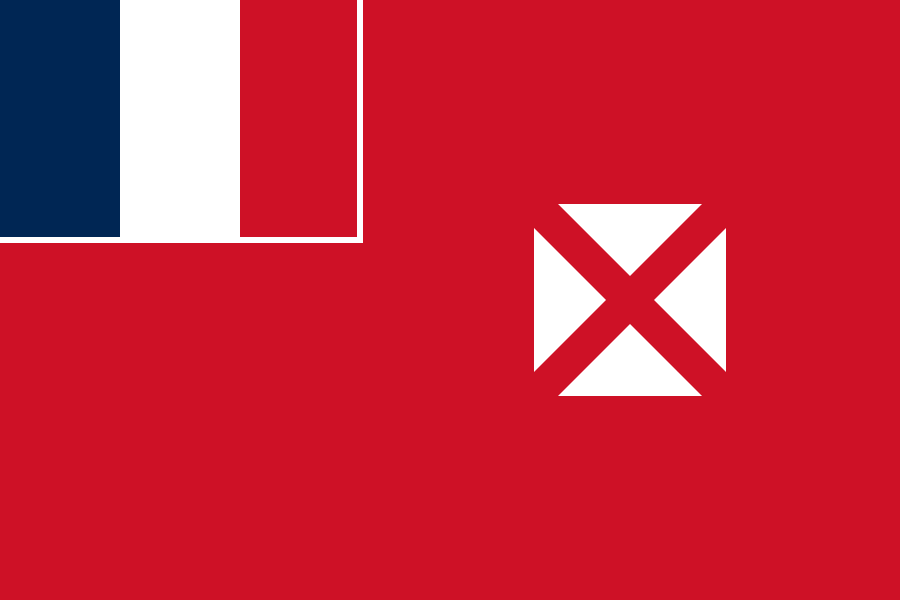
Wallis and Futuna
Territory of the Wallis and Futuna Islands
🏛️ Capital
Mata-Utu
👥 Population
11,620
📐 Area
142 km²
💱 Currency
CFP franc (₣)
🗣️ Languages
French
📞 Calling Code
+681
🕐 Time Zones
UTC+12:00
🌐 Region
Oceania / Polynesia
About Wallis and Futuna
Few places on Earth are as genuinely off the beaten path as Wallis and Futuna, a French collectivity of three volcanic islands sitting in the heart of the South Pacific, roughly halfway between Fiji and Samoa. With a population of barely 11,000 people and no international tourism infrastructure to speak of, these islands offer something increasingly rare in the modern world: pristine natural environments, deeply intact traditional Polynesian culture, and a pace of life so unhurried that the rest of the world feels very far away — because it is.
Wallis Island (Uvea) is dominated by the crater lake of Lalolalo, one of the most hauntingly beautiful freshwater lakes in the Pacific, ringed by jungle-draped basalt cliffs and accessible only on foot. The island is dotted with ancient stone fortifications — malae and tia parte structures built by early Tongans who once dominated the archipelago — that predate European contact by centuries. Futuna and its uninhabited twin Alofi, separated from Wallis by 230 kilometres of open ocean, are even more remote, with volcanic peaks, deserted black-sand beaches, and traditional villages where chiefs hold genuine authority under the chefferie system.
The French colonial presence is lightly felt here — a few government buildings, a cathedral, and some decent roads — but Polynesian Wallisian and Futunan cultures remain vigorously alive. Traditional feasts, ceremonial kava drinking, and communal church attendance shape the social calendar. Tourism infrastructure is minimal: there are small guesthouses rather than resorts, no beach bars, and almost no organised tourist attractions. You come to Wallis and Futuna not to be entertained but to discover, on your own terms, one of the last genuinely unspoiled corners of the Pacific world.
Wallis Island (Uvea) is dominated by the crater lake of Lalolalo, one of the most hauntingly beautiful freshwater lakes in the Pacific, ringed by jungle-draped basalt cliffs and accessible only on foot. The island is dotted with ancient stone fortifications — malae and tia parte structures built by early Tongans who once dominated the archipelago — that predate European contact by centuries. Futuna and its uninhabited twin Alofi, separated from Wallis by 230 kilometres of open ocean, are even more remote, with volcanic peaks, deserted black-sand beaches, and traditional villages where chiefs hold genuine authority under the chefferie system.
The French colonial presence is lightly felt here — a few government buildings, a cathedral, and some decent roads — but Polynesian Wallisian and Futunan cultures remain vigorously alive. Traditional feasts, ceremonial kava drinking, and communal church attendance shape the social calendar. Tourism infrastructure is minimal: there are small guesthouses rather than resorts, no beach bars, and almost no organised tourist attractions. You come to Wallis and Futuna not to be entertained but to discover, on your own terms, one of the last genuinely unspoiled corners of the Pacific world.
History & Background
Archaeological evidence suggests Wallis and Futuna were first settled by Lapita people around 1000 BCE, the same seafaring culture that colonised much of Polynesia. Tongan expansion between the 15th and 17th centuries brought significant cultural and linguistic influence to Wallis (Uvea), whose people retain Tongan-influenced traditions and the ancient stone fortifications built during that era. Futuna's history was more insular, with its own kingdoms developing independently.
Dutch explorers were the first Europeans to arrive, landing on Futuna in 1616. The Marist missionaries who arrived in 1837 had a transformative impact: St Peter Chanel, martyred on Futuna in 1841, became the first Catholic martyr of Oceania and is now the patron saint of the territory. France formally claimed the islands in 1888, and they remained an overseas territory through French colonialism and two world wars. During World War II, Wallis hosted a large American military base at the height of Pacific campaigns. In 1961, a referendum confirmed the islands' status as a French overseas collectivity, an arrangement that endures today with significant local autonomy under the traditional chefferie system.
Dutch explorers were the first Europeans to arrive, landing on Futuna in 1616. The Marist missionaries who arrived in 1837 had a transformative impact: St Peter Chanel, martyred on Futuna in 1841, became the first Catholic martyr of Oceania and is now the patron saint of the territory. France formally claimed the islands in 1888, and they remained an overseas territory through French colonialism and two world wars. During World War II, Wallis hosted a large American military base at the height of Pacific campaigns. In 1961, a referendum confirmed the islands' status as a French overseas collectivity, an arrangement that endures today with significant local autonomy under the traditional chefferie system.
Culture & People
The culture of Wallis and Futuna is rooted in traditional Polynesian social structures that have survived remarkably intact despite two centuries of French influence and Catholic missionary activity. Each island group is governed by its own traditional kingdom — the Kingdom of Uvea on Wallis, and the Kingdoms of Sigave and Alo on Futuna — whose kings (lavelua and keletaona) hold genuine ceremonial and social authority alongside the French-appointed administrator. This dual governance structure is unique in the Pacific and functions with surprisingly little tension.
Community life revolves around extended family clans, village churches, and traditional ceremonies that mark agricultural cycles, chiefly investitures, and life passages. The Wallisian and Futunan languages are distinct from each other and from other Pacific tongues, and both remain the primary languages of daily life. Traditional crafts — mat weaving, bark cloth (tapa) making, and wood carving — continue to be practised for ceremonial use rather than commercial sale. The Catholic faith, introduced by Marist missionaries in the 1830s, has merged seamlessly with indigenous tradition, and Sunday mass in a brightly decorated village church is a social event of deep communal importance.
Community life revolves around extended family clans, village churches, and traditional ceremonies that mark agricultural cycles, chiefly investitures, and life passages. The Wallisian and Futunan languages are distinct from each other and from other Pacific tongues, and both remain the primary languages of daily life. Traditional crafts — mat weaving, bark cloth (tapa) making, and wood carving — continue to be practised for ceremonial use rather than commercial sale. The Catholic faith, introduced by Marist missionaries in the 1830s, has merged seamlessly with indigenous tradition, and Sunday mass in a brightly decorated village church is a social event of deep communal importance.
Food & Cuisine
Food in Wallis and Futuna reflects the islands' Polynesian heritage filtered through French colonial influence and the rhythms of subsistence agriculture and fishing. The traditional diet centres on taro, breadfruit, yam, and freshly caught reef fish, prepared in a combination of earth oven (umu) cooking and modern stovetop methods. Coconut cream enriches both savoury dishes and sweet puddings, and freshly grated coconut accompanies nearly every meal in some form. Fish and seafood — tuna, snapper, lobster, and sea urchin — are abundant and form the backbone of daily protein.
French baguettes, baked fresh each morning and delivered across the islands, have become an unexpected culinary staple, and you'll find simple boulangeries in Mata-Utu alongside small Chinese-run stores stocking basic goods. Traditional feasts — held for ceremonies, chiefly meetings, and religious celebrations — are extraordinary communal events where entire communities gather to prepare and share enormous quantities of food. If you are fortunate enough to be invited to a feast, accept without hesitation: the generosity and scale of traditional Wallisian and Futunan hospitality is something few visitors outside the islands have ever witnessed. Kava, prepared from ground root, is consumed at village gatherings and marks every significant social occasion.
French baguettes, baked fresh each morning and delivered across the islands, have become an unexpected culinary staple, and you'll find simple boulangeries in Mata-Utu alongside small Chinese-run stores stocking basic goods. Traditional feasts — held for ceremonies, chiefly meetings, and religious celebrations — are extraordinary communal events where entire communities gather to prepare and share enormous quantities of food. If you are fortunate enough to be invited to a feast, accept without hesitation: the generosity and scale of traditional Wallisian and Futunan hospitality is something few visitors outside the islands have ever witnessed. Kava, prepared from ground root, is consumed at village gatherings and marks every significant social occasion.
Top Attractions
- Lake Lalolalo, Wallis — A breathtaking volcanic crater lake of vivid emerald-green water ringed by basalt cliffs and jungle, accessible by a forest trail and utterly serene.
- Talietumu Fortification, Wallis — Ancient Tongan-era stone ramparts hidden in the forest, one of the most significant pre-European archaeological sites in the central Pacific.
- Mata-Utu Cathedral — An imposing and beautiful colonial-era Catholic cathedral at the heart of the capital, reflecting the deep faith woven into island life.
- Futuna Island — Wild, mountainous, and extraordinarily remote, Futuna's black-sand beaches, traditional villages, and dramatic volcanic interior reward intrepid visitors.
- Traditional Village Life — Engaging with the community through church visits, village festivals, and customary feasts offers a window into authentic Polynesian culture rarely experienced by outsiders.
Practical Travel Tips
- Flights to Wallis and Futuna operate only from Nouméa, New Caledonia — plan your routing well in advance as connections are infrequent and seats limited.
- Accommodation is extremely limited; book guesthouses (pensions) months ahead as there are very few beds available for visitors.
- Respect traditional authority — always seek permission before photographing ceremonies, entering villages, or accessing sites on customary land.
- Carry sufficient cash in CFP francs; there are very few ATMs and card payment is not widely available.
- French is the administrative language; learning a few words of Wallisian or Futunan earns genuine warmth from locals.
- Bring all medicines, toiletries, and specialist equipment you might need — shops stock only basic goods.
Visa Overview
Wallis and Futuna is a French overseas collectivity, so the same entry rules that apply to metropolitan France apply here. Citizens of EU countries and countries with visa-free access to France can enter without a visa. Citizens of most other countries will need to obtain a French Schengen visa in advance, though since Wallis and Futuna is an overseas territory rather than part of the Schengen Area, specific entry rules may differ — verify directly with the French embassy in your country. There is no dedicated tourist visa for Wallis and Futuna. Your passport must be valid for at least three months beyond your intended stay.
Getting Around
Wallis and Futuna is served by Air Calin (Air Calédonie International) with regular flights from Nouméa, New Caledonia, and less frequent connections to Fiji and Samoa. The flight from Nouméa takes approximately three hours. On Wallis Island, a paved road circles the island and rental cars are available in limited numbers — book through your guesthouse in advance. Travel between Wallis and Futuna is by inter-island aircraft or occasional boat service; the crossing by sea can be rough. On Futuna, roads are more basic and a 4WD vehicle is advisable for exploring inland areas.
Safety Notes
Wallis and Futuna is one of the safest destinations in the Pacific, with virtually no crime directed at visitors. The main safety considerations are natural: the islands sit in the cyclone belt, and tropical storms between November and April can disrupt travel plans significantly. Swimming at beaches and reefs carries the usual Pacific Ocean risks — strong currents, coral cuts, and marine creatures including sea urchins — so always check conditions with locals before entering the water. Medical facilities are basic; the main hospital is in Mata-Utu on Wallis, and serious medical cases require evacuation to Nouméa. Comprehensive travel insurance is essential.
Live Exchange Rates
Current exchange rates for currencies used in Wallis and Futuna.
CFP franc (XPF) ₣
Updated: 2026-10-06
CFP franc (XPF) ₣
Updated: 2026-10-06
| Currency Code | Rate |
|---|---|
| 1INCH | 0.088897 |
| AAVE | 0.000052 |
| ADA | 0.034877 |
| AED | 0.034514 |
| AFN | 0.607220 |
| AKT | 0.012281 |
| ALGO | 0.073178 |
| ALL | 0.770868 |
| AMD | 3.399998 |
| AMP | 14.656577 |
| ANG | 0.016900 |
| AOA | 8.608741 |
| APE | 0.058659 |
| APT | 0.011447 |
| AR | 0.002085 |
| ARB | 0.046100 |
| ARS | 14.284312 |
| ATOM | 0.005162 |
| ATS | 0.115311 |
| AUD | 0.013486 |
| AVAX | 0.000828 |
| AWG | 0.016823 |
| AXS | 0.007176 |
| AZM | 79.884591 |
| AZN | 0.015977 |
| BAKE | 36.614844 |
| BAM | 0.016390 |
| BAT | 0.089096 |
| BBD | 0.018796 |
| BCH | 0.000030 |
| BDT | 1.155303 |
| BEF | 0.338048 |
| BGN | 0.016390 |
| BHD | 0.003534 |
| BIF | 28.235732 |
| BMD | 0.009398 |
| BNB | 0.000012 |
| BND | 0.012025 |
| BOB | 0.112738 |
| BRL | 0.046978 |
| BSD | 0.009398 |
| BSV | 0.000471 |
| BSW | 22.838647 |
| BTC | 0.000000 |
| BTCB | 0.134508 |
| BTG | 0.014245 |
| BTN | 0.906143 |
| BTT | 25,279.321294 |
| BUSD | 0.009396 |
| BWP | 0.129348 |
| BYN | 0.028671 |
| BYR | 184.227434 |
| BZD | 0.018900 |
| CAD | 0.013410 |
| CAKE | 0.003843 |
| CDF | 21.718874 |
| CELO | 0.090367 |
| CFX | 0.171275 |
| CHF | 0.007817 |
| CHZ | 0.561829 |
| CLP | 9.144584 |
| CNH | 0.062995 |
| CNY | 0.063016 |
| COMP | 0.000383 |
| COP | 30.060998 |
| CRC | 4.300428 |
| CRO | 0.138395 |
| CRV | 0.025493 |
| CSPR | 3.684349 |
| CUC | 0.009399 |
| CUP | 0.225119 |
| CVE | 0.924063 |
| CVX | 0.004246 |
| CYP | 0.004905 |
| CZK | 0.205008 |
| DAI | 0.009402 |
| DASH | 0.000166 |
| DCR | 0.000510 |
| DEM | 0.016390 |
| DFI | 10.282899 |
| DJF | 1.671924 |
| DKK | 0.062632 |
| DOGE | 0.099117 |
| DOP | 0.563236 |
| DOT | 0.007596 |
| DYDX | 0.064323 |
| DZD | 1.263348 |
| EEK | 0.131119 |
| EGLD | 0.002103 |
| EGP | 0.492722 |
| ENJ | 0.283888 |
| EOS | 0.092481 |
| ERN | 0.140971 |
| ESP | 1.394315 |
| ETB | 1.528706 |
| ETC | 0.001059 |
| ETH | 0.000003 |
| EUR | 0.008380 |
| EURC | 0.008379 |
| FEI | 0.009402 |
| FIL | 0.007873 |
| FIM | 0.049825 |
| FJD | 0.021147 |
| FKP | 0.007112 |
| FLOW | 0.297035 |
| FLR | 1.303818 |
| FRAX | 0.009493 |
| FRF | 0.054969 |
| FTT | 0.036381 |
| GALA | 3.878950 |
| GBP | 0.007112 |
| GEL | 0.024393 |
| GGP | 0.007112 |
| GHC | 1,104.897407 |
| GHS | 0.110490 |
| GIP | 0.007112 |
| GMD | 0.695560 |
| GMX | 0.001070 |
| GNF | 82.629313 |
| GNO | 0.000077 |
| GRD | 2.855485 |
| GRT | 0.322766 |
| GT | 0.000840 |
| GTQ | 0.071721 |
| GUSD | 0.009417 |
| GYD | 1.961839 |
| HBAR | 0.093357 |
| HKD | 0.073751 |
| HNL | 0.251998 |
| HNT | 0.018112 |
| HOT | 20.521584 |
| HRK | 0.063139 |
| HT | 0.257667 |
| HTG | 1.228063 |
| HUF | 3.078419 |
| ICP | 0.002695 |
| IDR | 168.368474 |
| IEP | 0.006600 |
| ILS | 0.028741 |
| IMP | 0.007112 |
| IMX | 0.051254 |
| INJ | 0.001240 |
| INR | 0.906143 |
| IQD | 12.286443 |
| IRR | 16,902.655562 |
| ISK | 1.147485 |
| ITL | 16.225943 |
| JEP | 0.007112 |
| JMD | 1.487201 |
| JOD | 0.006663 |
| JPY | 1.485940 |
| KAS | 0.219064 |
| KAVA | 0.135564 |
| KCS | 0.001238 |
| KDA | 0.962603 |
| KES | 1.219952 |
| KGS | 0.821942 |
| KHR | 38.072511 |
| KLAY | 0.225652 |
| KMF | 4.122690 |
| KNC | 0.065612 |
| KPW | 8.459426 |
| KRW | 12.616555 |
| KSM | 0.001834 |
| KWD | 0.002905 |
| KYD | 0.007813 |
| KZT | 4.278737 |
| LAK | 210.880499 |
| LBP | 847.541444 |
| LDO | 0.020516 |
| LEO | 0.001057 |
| LINK | 0.000679 |
| LKR | 3.099784 |
| LRC | 0.915382 |
| LRD | 1.603768 |
| LSL | 0.156467 |
| LTC | 0.000135 |
| LTL | 0.028934 |
| LUF | 0.338048 |
| LUNA | 0.184038 |
| LUNC | 177.738411 |
| LVL | 0.005889 |
| LYD | 0.060299 |
| MAD | 0.093799 |
| MANA | 0.090880 |
| MBX | 0.317763 |
| MDL | 0.168433 |
| MGA | 41.618766 |
| MGF | 208.093830 |
| MINA | 0.069755 |
| MKD | 0.515592 |
| MKR | 0.000005 |
| MMK | 19.728166 |
| MNT | 33.787670 |
| MOP | 0.075963 |
| MRO | 3.762696 |
| MRU | 0.376270 |
| MTL | 0.003598 |
| MUR | 0.445489 |
| MVR | 0.145291 |
| MWK | 16.266437 |
| MXN | 0.169872 |
| MXV | 0.019311 |
| MYR | 0.038397 |
| MZM | 599.870991 |
| MZN | 0.599871 |
| NAD | 0.156467 |
| NEAR | 0.001798 |
| NEO | 0.003708 |
| NEXO | 0.011052 |
| NFT | 39,384.103014 |
| NGN | 12.424653 |
| NIO | 0.345502 |
| NLG | 0.018467 |
| NOK | 0.090201 |
| NPR | 1.450508 |
| NZD | 0.016790 |
| OKB | 0.000072 |
| OMR | 0.003617 |
| ONE | 0.064166 |
| OP | 0.069912 |
| ORDI | 0.002066 |
| PAB | 0.009398 |
| PAXG | 0.000002 |
| PEN | 0.032359 |
| PEPE | 2,173.045216 |
| PGK | 0.042341 |
| PHP | 0.590633 |
| PI | 0.107662 |
| PKR | 2.598566 |
| PLN | 0.036710 |
| POL | 0.085941 |
| PTE | 1.680039 |
| PYG | 54.903356 |
| QAR | 0.034209 |
| QNT | 0.000036 |
| QTUM | 0.009587 |
| ROL | 447.940244 |
| RON | 0.044794 |
| RPL | 0.004915 |
| RSD | 0.984268 |
| RUB | 0.797330 |
| RUNE | 0.012105 |
| RVN | 3.830436 |
| RWF | 13.852464 |
| SAND | 0.142918 |
| SAR | 0.035243 |
| SBD | 0.075830 |
| SCR | 0.133112 |
| SDD | 564.053279 |
| SDG | 5.640533 |
| SEK | 0.094400 |
| SGD | 0.012025 |
| SHIB | 1,605.475598 |
| SHP | 0.007112 |
| SIT | 2.008183 |
| SKK | 0.252456 |
| SLE | 0.216671 |
| SLL | 216.671204 |
| SNX | 0.037536 |
| SOL | 0.000078 |
| SOS | 5.347048 |
| SPL | 0.001566 |
| SRD | 0.354361 |
| SRG | 354.361481 |
| SSP | 53.819258 |
| STD | 206.764964 |
| STN | 0.206765 |
| STX | 0.025079 |
| SUI | 0.007875 |
| SVC | 0.082233 |
| SYP | 122.210466 |
| SZL | 0.156467 |
| THB | 0.316335 |
| THETA | 0.040586 |
| TJS | 0.086496 |
| TMM | 164.906691 |
| TMT | 0.032981 |
| TND | 0.028127 |
| TOP | 0.022635 |
| TRL | 462,155.084524 |
| TRX | 0.027967 |
| TRY | 0.462155 |
| TTD | 0.063632 |
| TUSD | 0.009405 |
| TVD | 0.013486 |
| TWD | 0.298688 |
| TWT | 0.016463 |
| TZS | 24.795719 |
| UAH | 0.423282 |
| UGX | 37.781564 |
| UNI | 0.001061 |
| USD | 0.009398 |
| USDC | 0.009401 |
| USDD | 0.009405 |
| USDP | 0.009454 |
| USDT | 0.009403 |
| UYU | 0.379645 |
| UZS | 110.550349 |
| VAL | 16.225943 |
| VEB | 818,312,026.546621 |
| VED | 8.183120 |
| VEF | 818,312.026547 |
| VES | 8.183120 |
| VET | 1.076944 |
| VND | 244.305987 |
| VUV | 1.129760 |
| WAVES | 0.031502 |
| WEMIX | 0.049075 |
| WOO | 0.686573 |
| WST | 0.026157 |
| XAF | 5.496920 |
| XAG | 0.000155 |
| XAU | 0.000002 |
| XAUT | 0.000002 |
| XBT | 0.000000 |
| XCD | 0.025440 |
| XCG | 0.016900 |
| XCH | 0.006005 |
| XDC | 0.279662 |
| XDR | 0.006947 |
| XEC | 1,178.526873 |
| XEM | 14.969140 |
| XLM | 0.043546 |
| XMR | 0.000017 |
| XOF | 5.496920 |
| XPD | 0.000008 |
| XPT | 0.000005 |
| XRP | 0.006255 |
| XTZ | 0.028128 |
| YER | 2.219800 |
| ZAR | 0.156467 |
| ZEC | 0.000007 |
| ZIL | 2.575455 |
| ZMK | 185.802912 |
| ZMW | 0.185803 |
| ZWD | 3.401157 |
| ZWG | 0.251600 |
| ZWL | 628.679982 |
No currencies match your search.
Visa Requirements
Check what visa a citizen of Wallis and Futuna needs to enter any country.
Frequently Asked Questions
What is the capital of Wallis and Futuna?
The capital of Wallis and Futuna is Mata-Utu.
What currency does Wallis and Futuna use?
Wallis and Futuna uses the CFP franc (₣) as its official currency.
What language is spoken in Wallis and Futuna?
The official language(s) of Wallis and Futuna include French.
What is the population of Wallis and Futuna?
Wallis and Futuna has a population of approximately 11,620 people.
What region is Wallis and Futuna in?
Wallis and Futuna is located in Oceania, specifically in the Polynesia subregion.
What is the international calling code for Wallis and Futuna?
The international dialing code for Wallis and Futuna is +681.
What time zones does Wallis and Futuna observe?
Wallis and Futuna observes the following time zone(s): UTC+12:00.
What is the current time in Wallis and Futuna?
The local time in Wallis and Futuna is currently --:--. This time applies to the primary time zone.
What is the total area of Wallis and Futuna?
Wallis and Futuna covers a total area of 142 km².
How many states or provinces does Wallis and Futuna have?
Wallis and Futuna is divided into 3 states or provinces.
What are the public holidays in Wallis and Futuna in 2026?
You can view the complete list of public holidays for Wallis and Futuna in 2026 on the Holidays 2026 page.
What are the visa requirements for citizens of Wallis and Futuna?
Visa requirements for citizens of Wallis and Futuna vary by destination. Use our Visa Requirements Checker below to look up requirements for any destination country.