
Introduction: The World's Best-Kept Secrets
Let's play a quick game. I'll name a country, and you tell me everything you know about it. Ready?
How about... Nauru? Tuvalu? Comoros?
If you're drawing a blank, don't worry—you're not alone. Most of us can rattle off the usual suspects: France, Japan, Brazil, Australia. But the world has nearly two hundred sovereign nations, and I'd bet my last passport stamp that at least a dozen of them are complete mysteries to the average person.
Here's the thing: these "unknown" countries aren't obscure for lack of interesting stories. Far from it. We're talking about places where jellyfish don't sting, where the world's first sunrise paints the sky every single day, where chocolate once ruled the economy, and where people still leap from hundred-foot towers with nothing but vines around their ankles.
These nations might be small in size or population, but they're giants when it comes to fascinating facts, unique cultures, and jaw-dropping natural wonders. They're also facing some of the most pressing challenges of our time, from climate change threatening their very existence to economic transitions that could serve as lessons for the rest of the world.
So grab your virtual passport. We're about to explore ten countries you've probably never heard of—but will never forget.
Why Do Some Countries Remain Unknown?
Before we dive into our list, let's address the obvious question: why haven't you heard of these places?
It usually comes down to a few straightforward factors:
- Size matters: Microstates with populations smaller than a typical university campus rarely make international headlines
- Geographic isolation: Remote Pacific islands or tiny European enclaves don't sit on major trade or travel routes
- Tourism numbers: Some of these countries receive fewer than five thousand visitors annually, keeping them off mainstream travel radars
- Media coverage: Without dramatic conflicts or massive economic output, they simply don't dominate the news cycle
But here's what's wild: obscurity doesn't mean insignificance. Many of these nations punch way above their weight in terms of environmental importance, cultural heritage, and pure geographical weirdness.
The 10 Countries That Deserve Your Attention
1. Nauru: The Island That Struck Gold (Then Lost It All)
Where: Micronesia, Pacific Ocean
Population: Approximately 11,000
Claim to Fame: Once the richest country per capita on Earth
Picture this: a tiny speck of an island, just eight square miles, sitting alone in the vast Pacific. In the 1970s and 80s, Nauru wasn't just any island—it was a phosphate goldmine. Literally.
Bird droppings had accumulated on this island for thousands of years, creating phosphate deposits so rich they made Nauruans extraordinarily wealthy. At its peak, the country boasted one of the highest per capita incomes globally, with citizens enjoying free healthcare, education, and no income taxes.
The Downfall
But here's where the story takes a tragic turn. By the 2010s, the phosphate reserves were exhausted. Decades of intensive strip mining left about eighty percent of the island's land uninhabitable, creating a barren, jagged landscape of coral pinnacles. Poor investments and financial mismanagement drained the sovereign wealth fund that was supposed to secure the nation's future.
Today, Nauru faces serious economic challenges and is working to diversify beyond phosphate mining. The country now relies heavily on fishing licenses, limited financial services, and international aid partnerships.
Why You Should Care: Nauru is a cautionary tale about the resource curse—what happens when a country's entire economy depends on one finite commodity. It's also a stark reminder of environmental degradation's long-term consequences.
2. Tuvalu: The Country Fighting to Exist
Where: Polynesia, Pacific Ocean
Population: Approximately 12,000
Claim to Fame: The least-visited country on Earth and ground zero for climate change
If you've never heard of Tuvalu, you're in the majority. This nation consistently ranks as the least-visited country globally. But Tuvalu's obscurity isn't by choice—it's fighting for survival.
The Sinking Reality
Here are the chilling facts:
- Sea levels around Tuvalu have risen significantly over the past few decades
- No island in the country rises more than five meters above sea level
- Scientists project that ninety-five percent of Tuvalu could be underwater at high tide by the end of the century
- More than half of the capital, Funafuti, is projected to be frequently submerged within the next few decades
This isn't some distant threat. Tuvaluans are living through it right now. Salt water contaminates freshwater supplies, king tides flood homes, and coastal erosion swallows land that families have occupied for generations.
The Digital Nation Solution
In a move that's both innovative and heartbreaking, Tuvalu has announced plans to preserve its culture, government, and sovereignty digitally if physical land becomes uninhabitable. It's a groundbreaking approach to national continuity in the face of environmental collapse.
Why You Should Care: Tuvalu's fate is a preview of what could happen to countless coastal communities worldwide. Their struggle puts a human face on climate change statistics.
3. Kiribati: Where Every Day Begins
Where: Central Pacific Ocean
Population: Approximately 130,000
Claim to Fame: The first country to see the sunrise each day
While the rest of the world sleeps, Kiribati wakes up to the dawn. Specifically, Kiritimati, part of Kiribati's Line Islands, holds the honor of greeting each new day before anywhere else on Earth.
The Time Zone Superpower
Kiribati straddles the International Date Line, and in the mid-1990s, the country made a bold administrative move: it shifted its eastern islands forward by a full day, essentially eliminating the date line's division through its territory. This means:
- Kiribati is up to fourteen hours ahead of New York
- When it's midnight on January first in Kiritimati, it's still the previous day in most of the world
- The country celebrates New Year's before anyone else
Geography That Defies Logic
Despite having a land area of just over three hundred square miles, Kiribati's thirty-three atolls and islands are scattered across one point four million square miles of ocean—that's larger than India. It's the only country in the world that spans all four hemispheres.
Why You Should Care: Kiribati demonstrates how human decisions can reshape our relationship with geography. Plus, it's also facing existential threats from rising sea levels, making its "first to see the sunrise" status beautifully bittersweet.
4. Comoros: The Perfume Islands
Where: Indian Ocean, between Madagascar and Mozambique
Population: Approximately 900,000
Claim to Fame: One of the world's leading producers of ylang-ylang, the "flower of flowers"
Close your eyes and imagine the scent of a luxury perfume. There's a strong chance you're smelling Comoros.
This volcanic archipelago is one of the world's primary sources of ylang-ylang, a fragrant flower that's essential to the global fragrance industry. The name literally means "flower of flowers," and its sweet, exotic scent appears in countless high-end scents.
The Scent Economy
Comoros's economy runs on aromatics:
- Ylang-ylang essential oil: Used in premium perfumes worldwide
- Vanilla: Grown in the volcanic soils, producing a lush, creamy note
- Cloves and nutmeg: Additional spice exports that support local farmers
On Mohéli, the smallest of the major islands, ylang-ylang cultivation is a way of life. The flowers are harvested by hand and distilled into essential oil using traditional methods passed down through generations.
Political Turbulence
Despite its natural beauty, Comoros has experienced significant political instability since independence, making it one of the region's more turbulent nations. Yet the islands persist, their volcanic soils continuing to produce some of the world's most prized botanical ingredients.
Why You Should Care: Every time you smell a fancy fragrance, there's a chance it contains essence from these forgotten islands. Comoros shows how a tiny nation can have an outsized impact on global luxury markets.
5. São Tomé and Príncipe: The Chocolate Islands
Where: Gulf of Guinea, off West Africa's coast
Population: Approximately 220,000
Claim to Fame: Once the world's largest cocoa producer
If you love chocolate, you owe a debt to São Tomé and Príncipe. In the early twentieth century, these two volcanic islands produced and exported more cocoa than anywhere else on Earth, earning them the nickname "The Chocolate Islands."
Cocoa Royalty
At the height of production:
- The islands were the world's top cocoa exporter
- They produced premium cocoa varieties still prized by artisan chocolate makers today
- Cocoa represented nearly all of the country's export revenue
The Rise, Fall, and Potential Renaissance
The cocoa boom was built on brutal forced labor systems, which eventually led to international boycotts and the industry's collapse. Today, São Tomé produces just a fraction of its former output, primarily exporting to European and Asian markets.
But there's hope. The country's cocoa agroforestry system, which combines traditional farming with diverse shade crops, has been recognized for its ecological sustainability. Artisanal chocolate makers are rediscovering São Tomé's premium beans, potentially sparking a renaissance for the islands' signature crop.
Why You Should Care: The story of São Tomé's cocoa is a microcosm of colonial history, ethical sourcing debates, and the modern quest for sustainable chocolate. Your favorite chocolate bar might have roots here.
6. Liechtenstein: The Denture Capital of the World
Where: Alpine microstate between Switzerland and Austria
Population: Approximately 39,000
Claim to Fame: World's largest exporter of false teeth
Here's a fact that'll make you do a double-take: this tiny principality, barely visible on most maps, produces roughly twenty percent of the world's false teeth.
The Smile Industry
Let that sink in. One in every five artificial teeth on Earth comes from Liechtenstein, a country smaller than Washington D.C. The country's precision manufacturing sector, particularly dental and medical products, has become a cornerstone of its economy.
More Than Just Teeth
While dentures might be the quirky headline, Liechtenstein is actually an economic powerhouse:
- One of the highest GDP per capita figures globally
- Highly industrialized with strong manufacturing, technology, and financial services sectors
- Home to more registered companies than residents, thanks to favorable business regulations
The country has managed to transition from a primarily agricultural economy to a high-tech industrial nation, all while maintaining its independence and avoiding the tourist hordes that overwhelm neighboring Switzerland.
Why You Should Care: Liechtenstein proves that size doesn't determine economic success. It's a masterclass in niche manufacturing and smart economic policy.
7. Dominica: Nature Island's Boiling Wonder
Where: Caribbean
Population: Approximately 72,000
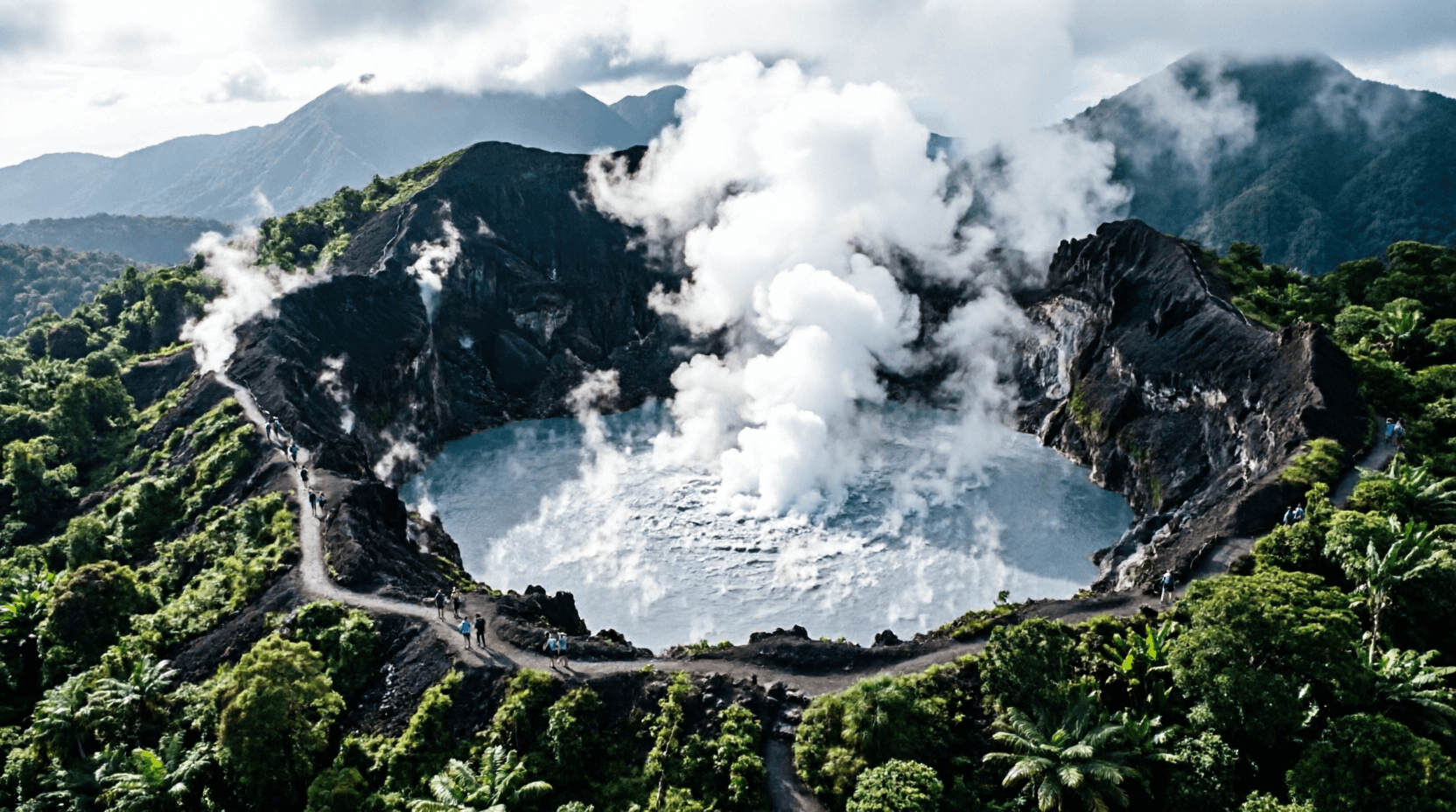
Claim to Fame: Home to the world's second-largest boiling lake
First things first: Dominica is not the Dominican Republic. This common mix-up drives locals crazy. Dominica is the "Nature Island" of the Caribbean, and it's hiding one of the planet's most surreal geological features.
The Boiling Lake
Tucked away in Morne Trois Pitons National Park lies a flooded fumarole that defies belief. The Boiling Lake is:
- Approximately two hundred to two hundred fifty feet across
- Filled with bubbling, greyish-blue water usually shrouded in vapor clouds
- Heated by volcanic activity from deep within the Earth
- Accessible via a challenging six-mile round-trip hike through rugged terrain
The lake has exhibited stable high-temperature behavior for over a century, though it occasionally drains completely before refilling, reminding visitors that this is a living, breathing geological system.
Beyond the Boil
Dominica isn't just about one weird lake. The island boasts:
- Lush rainforests covering much of the interior
- Hundreds of rivers and waterfalls
- The Caribbean's second-largest hot spring
- A national commitment to becoming the world's first climate-resilient country
Why You Should Care: Dominica represents ecotourism done right—prioritizing environmental protection while sharing natural wonders with the world.
8. Palau: Swimming with Gentle Jellyfish
Where: Western Pacific, part of Micronesia
Population: Approximately 18,000
Claim to Fame: Jellyfish Lake, where millions of harmless jellyfish migrate daily
Imagine swimming in a lake surrounded by millions of jellyfish... and actually enjoying it. In Palau's Jellyfish Lake, that's not just possible—it's magical.
The Jellyfish Phenomenon
Jellyfish Lake is a marine lake on Eil Malk island, isolated from the ocean thousands of years ago. Inside, millions of golden jellyfish perform a daily migration, following the sun across the water.
Here's what makes it special:
- The jellyfish have lost most of their sting due to isolation and lack of natural predators
- You can snorkel among them safely, though scuba diving is prohibited to protect the fragile ecosystem
- The lake requires a conservation permit for visitors, funding ongoing environmental protection
Protection First
Palau takes conservation seriously:
- Scuba diving is strictly forbidden in the lake because bubbles would damage the jellyfish and mix toxic gases from deeper water layers
- The country created one of the world's largest marine sanctuaries
- All visitors must sign an eco-pledge stamped directly into their passport upon arrival
Why You Should Care: Jellyfish Lake shows how isolation creates unique ecosystems, and how responsible tourism can protect them. It's a living laboratory of evolution.
9. Andorra: The Tax Haven in the Sky
Where: Pyrenees Mountains, between France and Spain
Population: Approximately 77,000
Claim to Fame: Europe's hidden mountain principality with world-class skiing
Nestled high in the Pyrenees Mountains, Andorra is a principality so small you could miss it if you blinked while driving from France to Spain. But this mountain microstate has an outsized reputation.
The Economic Advantage
For decades, Andorra has been known for its favorable economic policies, attracting shoppers and businesses with:
- Historically low taxes on many goods
- Duty-free shopping that made prices significantly lower than neighboring countries
- A streamlined regulatory environment for residents and businesses
However, times are changing. Since adopting international banking standards and implementing modern tax structures, Andorra is working to shed its traditional "tax haven" label while maintaining economic competitiveness.
Ski Paradise
Beyond economics, Andorra is a winter sports mecca:
- Grandvalira is the largest ski area in the Pyrenees with multiple connected sectors
- Year-round outdoor activities include hiking, mountain biking, and thermal spa tourism
- Spectacular mountain scenery at elevations averaging nearly two thousand meters
Why You Should Care: Andorra demonstrates how microstates can carve out economic niches while navigating pressure from larger neighbors and international regulators.
10. Vanuatu: Where Bungee Jumping Was Born
Where: South Pacific Ocean
Population: Approximately 320,000
Claim to Fame: Active volcanoes and the origin of bungee jumping
If you've ever watched someone leap off a platform with an elastic cord around their ankles, thank Vanuatu. This Pacific nation is the birthplace of bungee jumping—though they call it "land diving."
The Original Adrenaline Rush
On Pentecost Island, local men perform land diving during harvest season:
- They build wooden towers up to one hundred feet tall
- Vines are carefully measured and tied around their ankles
- They leap headfirst toward the ground, aiming to touch it with their shoulders
- This ancient ritual predates modern adventure sports by centuries
The ceremony is both a rite of passage and a prayer for good yam harvests. It's raw, dangerous, and deeply spiritual—nothing like the commercialized jumps you find in tourist destinations.
Volcanic Wonderland
Vanuatu isn't just about land diving:
- Nearly half of the country's volcanoes are considered active
- Mount Yasur on Tanna Island is one of the world's most accessible active volcanoes
- Visitors can hike to volcanic craters, witness glowing lava, and explore otherworldly landscapes
Why You Should Care: Vanuatu preserves ancient traditions while embracing adventure tourism. It's a reminder that some of the world's most thrilling experiences have deep cultural roots.
What These Countries Teach Us
After exploring these ten nations, a few clear themes emerge:
1. Size Doesn't Determine Significance
From Liechtenstein's dental dominance to Comoros's perfume empire, these countries prove that impact isn't proportional to square mileage.
2. Isolation Creates Uniqueness
Whether it's Palau's stingless jellyfish or Vanuatu's land diving tradition, geographic separation fosters extraordinary evolution, both biological and cultural.
3. Climate Change Is Already Here
Tuvalu and Kiribati aren't waiting for future predictions. They're living through rising seas right now, making them early warning systems for coastal communities worldwide.
4. Economic Creativity Is Essential
From Nauru's phosphate bust to Andorra's shifting policies, these nations show both the risks of depending on single industries and the rewards of strategic diversification.
5. The World Is Bigger Than Your Map
There are entire countries most of us have never heard of, each with rich histories, unique challenges, and fascinating cultures. Our worldview is only as broad as our curiosity.
How to Explore These Hidden Nations (Responsibly)
If these stories have sparked your wanderlust, here's how to engage thoughtfully:
Do Your Research
Understand each country's current situation. Some face existential environmental threats, while others are rebuilding after natural disasters or economic shifts.
Travel Off-Season
Many of these destinations have fragile infrastructure. Visiting during shoulder seasons reduces pressure on local resources and gives you a more authentic experience.
Support Local Economies
Choose locally-owned accommodations, guides, and restaurants. Your spending can make a meaningful difference in small economies.
Respect Cultural Traditions
These aren't theme parks. Places like Vanuatu's land diving ceremonies are sacred rituals, not photo opportunities. Always ask permission and follow local guidelines.
Consider Virtual Learning
For countries that receive very few visitors or are environmentally sensitive, learning about them through documentaries, books, and responsible media can be just as valuable as physical travel.
Conclusion: The World's Hidden Chapters
Here's the truth: most world maps are incomplete. Not because they show incorrect borders, but because they suggest that the story of our planet is contained only in the countries we've all heard of.
The reality is far richer. In a tiny Pacific atoll, the day begins before anywhere else. In an Indian Ocean archipelago, flowers are distilled into scents that define luxury. In a Caribbean rainforest, water boils from the heat of the Earth itself. In an Alpine principality, precision-crafted dental products serve millions of smiles worldwide.
These ten countries might not dominate headlines or appear on every traveler's bucket list. But they hold lessons about resilience, innovation, environmental stewardship, and cultural preservation that the entire world needs to hear.
They remind us that significance isn't measured in square miles or gross domestic product. That traditions can survive for centuries in remote corners. That climate change isn't a future threat but a present reality. That the world is far stranger, more beautiful, and more interconnected than we imagine.
So the next time someone asks you to name a country, skip the obvious answers. Tell them about the chocolate islands of Africa, the boiling lake of the Caribbean, or the Pacific nation where jellyfish don't sting. Watch their eyes widen. Then tell them there are dozens more stories where those came from.
Because the world's best-kept secrets aren't hidden in some uncharted territory. They're right there on the map, waiting for curious minds to discover them.
💬 Comments (0)
No comments yet. Be the first to share your thoughts!
Leave a Comment